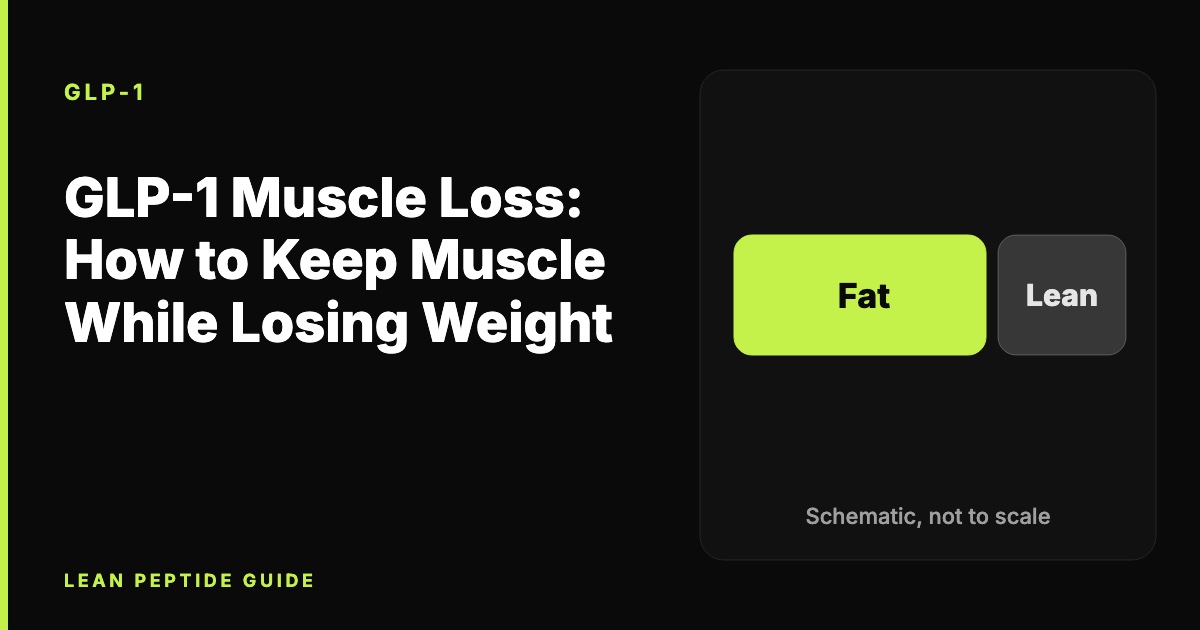
Quick answer: When people lose weight, some of what they lose is lean mass, with or without a GLP-1 drug. In the SURMOUNT-1 body-composition substudy, about 75% of weight lost on tirzepatide was fat and about 25% lean mass. Expert guidance recommends adequate protein and regular strength training. We found no completed trial showing that either one protects muscle on semaglutide or tirzepatide, so no plan can be promised to keep muscle.
Losing weight quickly raises a fair worry: what exactly is leaving? This page separates what DXA scans measured, what guidelines advise, and what nobody has yet tested. Some links here are affiliate links, and we may earn a commission if you use them; see our affiliate disclosure. We do not claim any product keeps muscle. Related reading: tirzepatide vs semaglutide and peptides for muscle growth.
Lean mass is not the same as muscle
Studies of body composition usually use DXA, a scan that sorts body weight into fat, bone and "lean" mass. Lean mass includes skeletal muscle, but also water and organs. A drop in lean mass is therefore not automatically a drop in muscle, and the percentage of weight lost that is "lean" shifts with how it is measured. A 2026 analysis in the American Journal of Clinical Nutrition of diet-only weight loss (374 adults over 6 months) reported muscle loss of under 10% of the mass lost after adjusting for fat-free adipose tissue. That is not a GLP-1 finding; it shows how the method changes the answer.
Keep that in mind for every number below. They are real measurements, but they are measurements of lean mass, and they carry wide ranges.
What the trials measured
All the figures below come from trials of the approved brand drugs given with lifestyle intervention. They do not describe compounded products, which are not FDA-approved and were not tested this way.
STEP 1 body-composition substudy (semaglutide). In a DXA substudy reported by Wilding and colleagues in the Journal of the Endocrine Society in 2021, 140 participants (95 on semaglutide, 45 on placebo) had scans. In the substudy, weight changed by -15.0% with semaglutide against -3.6% with placebo. Total fat mass fell by 19.3%, visceral fat by 27.4% and total lean mass by 9.7%. The lean mass share of body weight rose by 3.0 percentage points, and the lean-to-fat ratio went from 1.34 to 1.57 at week 68. We saw secondary web pages claiming a "roughly 45% of weight lost was lean" figure for STEP 1; the abstract does not state a lean proportion of weight lost, so we do not use that number.
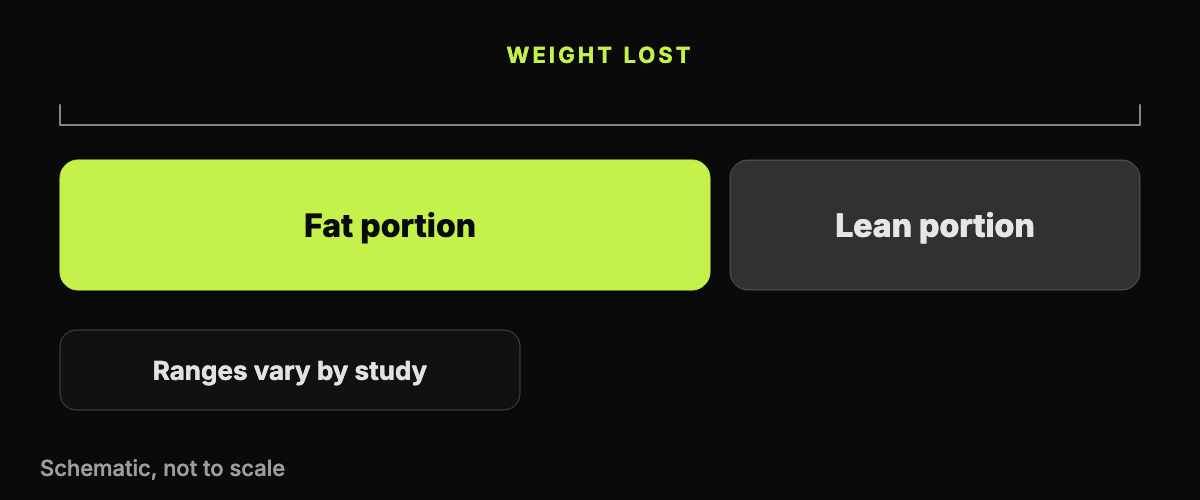
SURMOUNT-1 body-composition substudy (tirzepatide). A substudy published in Diabetes, Obesity and Metabolism in 2025 scanned 160 participants. At week 72, tirzepatide changed body weight by -21.3%, fat mass by -33.9% and lean mass by -10.9%; placebo changed them by -5.3%, -8.2% and -2.6%. The abstract states that about 75% of the weight lost was fat mass and about 25% lean mass, for both tirzepatide and placebo, consistent across subgroups.
That last sentence is worth rereading. In this substudy the lean share of lost weight was similar for the drug and for placebo, even though the amount lost was larger on the drug. It does not say the loss is harmless; it says that losing weight tends to bring some lean tissue with it.
What reviews add
A 2026 meta-analysis of 20 randomized trials (15,782 participants), published in Diabetes, Obesity and Metabolism, reported that lean mass made up 25% to 39% of total weight lost with incretin drugs. By drug the figures were 35.2% for semaglutide, 25.4% for tirzepatide and 26.8% for liraglutide. Lifestyle-only weight loss was 26.2%, and lifestyle plus resistance training was 17.5%. The pooled trials differ in design and population, and the abstract shows confidence intervals, so these numbers should not be used to rank one drug over another.
The protocol paper for a trial called LEAN-PREP, published in BMJ Open on 2026-04-22, notes in its background that lean mass has been reported at roughly 15% to 50% of total weight loss with these agents across studies. Read together, the sources point to a wide range, not a fixed percentage, and the safest summary is that some lean tissue loss is typical with weight loss in general.
Protein: what the guidance says
Nobody should hand you a personal protein number from an article. What we can do is report what a published guidance document says, with the usual caveat that individual targets are set by a clinician or dietitian.
A joint advisory from the American College of Lifestyle Medicine, the American Society for Nutrition, the Obesity Medicine Association and The Obesity Society (American Journal of Clinical Nutrition, 2025) cites the standard recommended dietary allowance of 0.8 g per kg of body weight per day. It recommends 1.2 to 1.6 g per kg per day during active weight reduction, and 1.2 to 1.7 g per kg per day when combined with strength training. For people with obesity it gives a range of 1.2 to 2.0 g per kg of adjusted body weight, or 80 to 120 g per day. It advises against intakes below 0.4 to 0.5 g per kg per day and against long-term intakes above 2 g per kg per day. The advisory also acknowledges real uncertainty about which body weight to use in the calculation.
Two honest notes follow. First, appetite on these drugs can fall, and the guidance does not claim that reaching a protein target is easy. Second, a 2018 meta-analysis in the British Journal of Sports Medicine of 49 trials (1,863 participants) in healthy adults doing resistance training found protein supplements added a modest 0.30 kg of fat-free mass, with no further gain above a total intake of 1.62 g per kg per day. That population was not people on GLP-1 drugs, and the effect was small.
Strength training: what the guidance says
The CDC, citing the Physical Activity Guidelines for Americans (page updated 2023-12-20), says adults need 2 days a week of muscle-strengthening activity that covers all major muscle groups, along with 150 minutes of moderate aerobic activity weekly. The federal ODPHP summary (updated 2025-11-19) agrees, giving lifting weights or push-ups at least 2 days each week. The 2025 joint advisory above is more demanding, recommending resistance training at least 3 times weekly and stating that protein alone is likely inadequate without it.
Those are different documents with different aims, and the gap between 2 and 3 days is a reminder that guidelines are starting points. Anyone with a joint problem, heart condition or long break from exercise should talk to a clinician before starting a program.
What no trial has shown yet
This is the honest center of the page. We searched for a completed, published randomized trial of protein or resistance training alongside semaglutide or tirzepatide and did not find one. That is an absence we could not prove, since we searched Europe PMC and PubMed-indexed titles only, but it is what the available record suggests.
- Lundgren and colleagues (New England Journal of Medicine, 2021) studied liraglutide, not semaglutide or tirzepatide. After an 8-week low-calorie diet (mean 13.1 kg lost), 166 adults were randomized for one year to exercise, liraglutide, both, or placebo. The combination decreased body-fat percentage by 3.9 points, about twice the exercise-only group, and only the combination improved HbA1c, insulin sensitivity and fitness. It is a weight-maintenance trial on a different drug. It did not test protein.
- LEAN-PREP is a registered protocol with no results. It plans a single-center, 6-month, four-arm trial of 232 people on semaglutide or tirzepatide: control, home resistance exercise 3 times a week, protein at 1.6 g per kg per day, or both, with MRI quadriceps area as the main outcome. Its authors list limitations, including a single center and no blinding of participants. It cannot be cited as showing an effect.
- Bimagrumab plus semaglutide (Nature Medicine, 2026) was a phase 2 trial of 507 adults over 48 weeks. Bimagrumab is an investigational drug, and the abstract we read gave no lean-mass numbers. It is not evidence about protein or training.
So the practical truth is this: guidance documents say what experts advise, and some of that guidance is reasonable and low in risk. But nothing we found tests whether following it keeps muscle on these two drugs. Any provider, brand or influencer who says a plan will keep your muscle is claiming more than the record supports.
What to ask a prescriber
These questions fit the evidence above:
- Is body composition, not only scale weight, something we will track, and how?
- What protein target is right for me, given my kidneys, diet and appetite?
- Does a dietitian referral make sense?
- Which strength activities are safe for my joints and history?
- What is the plan if my appetite is very low and I cannot eat enough?
- What is the plan for stopping, given the regain figures reported in the trials?
Whoosh Wellness, our partner, states that it connects people 18 or older to physician-prescribed protocols, including compounded semaglutide and tirzepatide, which are not FDA-approved. A licensed physician decides whether a prescription is appropriate, and Whoosh states that completing intake does not guarantee one. We make no claim that a Whoosh product, or any plan, keeps muscle. For how compounded products differ from the approved drugs, see compounded GLP-1s explained.
A one-page checklist
We turned the points above into a one-page checklist you can bring to an appointment. It is a set of questions and reminders, not a plan, and it promises no result. It contains:
- A short reminder of what DXA lean mass does and does not mean, so numbers in a report are read in context.
- The protein guidance from the 2025 joint advisory, written as guidance from its authors with a blank line for a clinician's personal target.
- The CDC and ODPHP muscle-strengthening guideline, with a space to note any limits your clinician sets.
- The six prescriber questions above, ready to read aloud.
- A place to record body-composition checks and how appetite is going.
- A line stating that no trial has yet shown that protein or training keeps muscle on semaglutide or tirzepatide.

Sources
- STEP 1 DXA substudy, Wilding et al., J Endocr Soc 2021 (Europe PMC)&format=json&resultType=core&pageSize=1) read 2026-10-06
- SURMOUNT-1 DXA substudy abstract (PMID 39996356), NCBI read 2026-10-06
- Meta-analysis of lean mass and incretin therapy (PMID 41877354), Europe PMC read 2026-10-06
- LEAN-PREP protocol, BMJ Open 2026 read 2026-10-06
- Diet-only weight loss and muscle loss, AJCN 2026 (Europe PMC) read 2026-10-06
- Lundgren et al., NEJM 2021, liraglutide and exercise (Europe PMC) read 2026-10-06
- Bimagrumab plus semaglutide, Nature Medicine 2026 (Europe PMC) read 2026-10-06
- Joint advisory on protein and weight reduction, ACLM, ASN, OMA and TOS, AJCN 2025 read 2026-10-06
- CDC: physical activity guidelines for adults read 2026-10-06
- ODPHP: top 10 things to know about the physical activity guidelines read 2026-10-06
- Morton et al., BJSM 2018, protein supplementation and resistance training (PMID 28698222) read 2026-10-06
- Whoosh Wellness terms and conditions read 2026-10-06
FAQ
Do GLP-1 drugs cause muscle loss?
Weight loss in general brings some loss of lean mass. In the SURMOUNT-1 substudy, about 25% of the weight lost on tirzepatide was lean mass, and the same share was reported for placebo. Lean mass is not purely muscle, so the scan number overstates muscle loss to an unknown degree.
How much of the weight lost is lean mass?
It depends on the study. The 2026 meta-analysis reported 25% to 39% for incretin drugs, and a trial protocol cited a wider 15% to 50% across studies. Read it as a range, not a rule.
How much protein does guidance suggest?
The 2025 joint advisory cites 0.8 g per kg per day as the standard allowance and 1.2 to 1.6 g per kg per day during active weight reduction. Your personal target should come from a clinician or dietitian, who can account for kidney health and which body weight to use.
Does strength training keep muscle on semaglutide or tirzepatide?
We found no completed trial that tested it. CDC guidance recommends 2 days a week of muscle-strengthening activity for adults generally, and the 2025 advisory recommends at least 3, but guidance is not trial evidence for these drugs.
Does the liraglutide exercise trial apply to semaglutide?
Not directly. Lundgren and colleagues studied liraglutide in a weight-maintenance setting. It is useful context, but it is a different drug and a different question.
Are compounded versions different for muscle?
No trial tested them. Compounded versions are not FDA-approved, and no lean-mass finding in this article applies to them.
Is a checklist enough?
A checklist helps organize questions; it does not replace medical advice. Bring it to a prescriber or dietitian who knows your history.
Not medical advice. See the medical disclaimer.