Quick answer: Two peptide drugs are FDA-approved for weight management: semaglutide, sold as Wegovy, and tirzepatide, sold as Zepbound. Both require a prescription. Retatrutide has strong trial results but is not FDA-approved. AOD-9604 and 5-Amino-1MQ have no approved use for weight loss, and the human evidence is thin or absent. "Peptide" is a broad word, so the label on the vial matters less than the evidence behind it.
Search results for this topic mix approved medicines, drugs still in trials and compounds sold with big promises. This page sorts them by how much evidence exists, using FDA labels, published trial abstracts and FDA statements, each named in the sentence that relies on it.
What a peptide is, in plain terms
A peptide is a short chain of amino acids, the same building blocks that make up proteins. Your body already makes many peptides, including insulin and the gut hormone GLP-1. The word describes size and structure. It does not describe safety, quality or whether something works.
That is why a page about "peptides for weight loss" has to cover very different things. Some are manufactured drugs that went through large trials and FDA review. Others are compounds a lab or a seller has named, with a mouse study or nothing at all behind them. For a closer look at the vocabulary, see peptides vs GLP-1.
The FDA-approved peptide drugs
Semaglutide (Wegovy)
According to the Wegovy label on DailyMed, Wegovy is indicated for weight reduction alongside diet and activity, in adults with obesity, in patients 12 and over with obesity, and in adults who are overweight with a related condition. The injection label also carries a separate cardiovascular indication for adults with established heart disease.
A tablet form followed. Novo Nordisk states that FDA approved Wegovy tablets on 2025-12-22 as the first oral GLP-1 for weight management. The combined Wegovy label, revised 6/2026, adds a further indication for a liver condition called noncirrhotic MASH with moderate-to-advanced fibrosis, granted under accelerated approval.
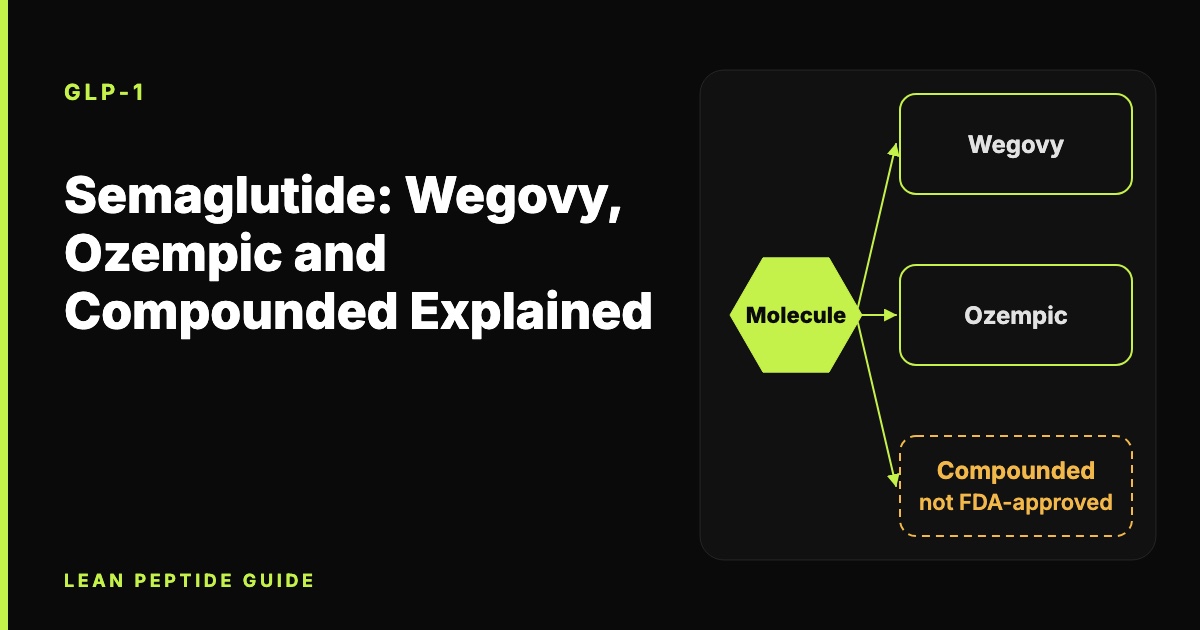
Semaglutide also appears under other brand names. The Ozempic label lists type 2 diabetes uses, and Rybelsus is an oral form with diabetes uses. Those labels describe different indications from Wegovy, so a brand name tells you which use FDA reviewed.
Tirzepatide (Zepbound)
The Zepbound label says it is indicated for adults, together with a lower-calorie diet and more activity, to lower excess weight and keep it off, whether they have obesity or are overweight with a related condition. A second indication covers moderate to severe obstructive sleep apnea in adults with obesity.
Mounjaro contains the same active ingredient, tirzepatide, and its label lists type 2 diabetes. Zepbound's label states not to combine it with other tirzepatide products or with any GLP-1 receptor agonist.
What the labels say about risk
Both drugs carry a boxed warning about thyroid C-cell tumors. The Wegovy label says semaglutide caused them in rodents at clinically relevant exposures, with human relevance not determined. The Zepbound label says tirzepatide caused them in rats. Each label counts a history of medullary thyroid carcinoma, in the patient or a relative, or of the inherited MEN 2 syndrome, as a reason not to prescribe. The full risk picture is on our safety page.
Common reactions are digestive. The Wegovy injection label reports nausea 44%, diarrhea 30%, vomiting 24% and constipation 24% in adults. The Zepbound label reports ranges in its trials of about 25-29% for nausea and 19-23% for diarrhea, across doses.
What the trials showed for the approved drugs
Trial figures belong to the branded drug, in a defined population, alongside lifestyle intervention. They do not describe compounded versions, which were not studied this way.
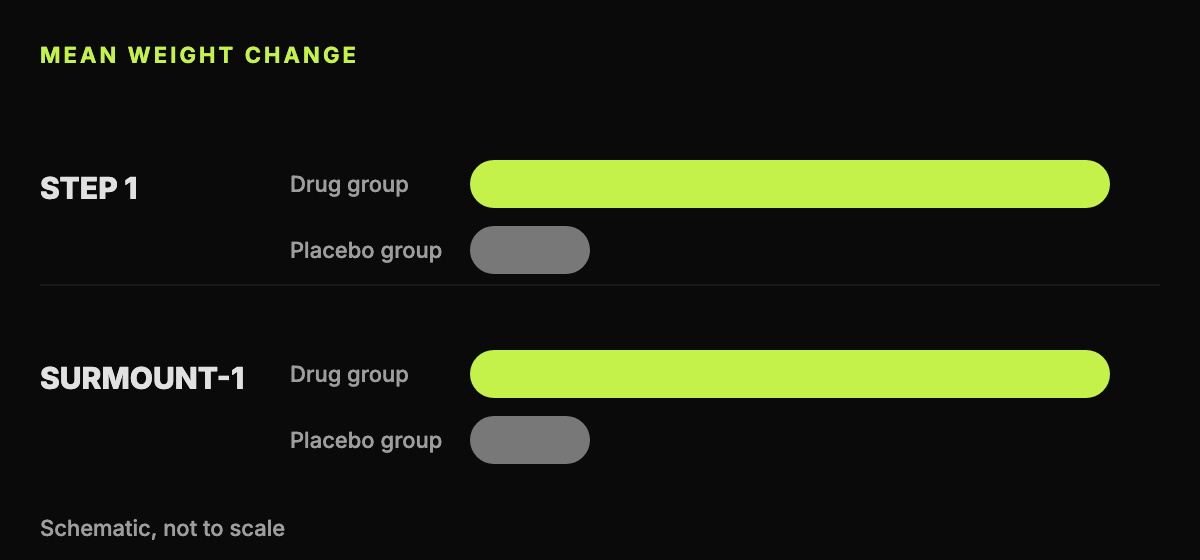
- STEP 1 (semaglutide 2.4 mg, NEJM 2021): 1,961 adults with obesity, or overweight plus a weight-related condition, without diabetes. Over 68 weeks, mean body weight changed by -14.9% with semaglutide versus -2.4% with placebo, both groups receiving lifestyle intervention. Weight reduction of at least 5% occurred in 86.4% versus 31.5%.
- SURMOUNT-1 (tirzepatide, NEJM 2022): 2,539 adults without diabetes. The week-72 averages were -15.0%, -19.5% and -20.9% at the 5, 10 and 15 mg doses, and -3.1% on placebo.
- SURMOUNT-5 (head to head, NEJM 2025): 751 adults with obesity without type 2 diabetes, open-label, 72 weeks. Mean change was -20.2% with tirzepatide versus -13.7% with semaglutide at the maximum tolerated dose.
Two cautions apply. Averages hide a wide spread between people. And a result from a supervised trial with scheduled visits is not a forecast for any individual.
Stopping matters too. In the STEP 1 extension, 327 participants regained 11.6 percentage points of the lost weight in the year after withdrawal. In SURMOUNT-4, people who switched to placebo after a lead-in saw a mean change of +14.0% from week 36 to week 88, while those who continued tirzepatide saw -5.5%.
What is not approved for weight loss
Retatrutide
Retatrutide acts on three receptors: GIP, GLP-1 and glucagon, according to the TRIUMPH-2 abstract in The Lancet. It is not FDA-approved. Lilly's Q2 2026 earnings release, filed with the SEC on 2026-08-05, says the data package is complete to support registrations and that Lilly plans to submit a Biologics License Application to FDA in Q1 2027.
The published trials report weight change versus placebo at 80 weeks. In TRIUMPH-1 (NEJM, online 2026-09-29), 2,339 adults with obesity had a mean change of -17.6%, -23.7% and -25.0% at 4, 9 and 12 mg versus -3.9% with placebo. TRIUMPH-2 (The Lancet), in 1,152 adults with type 2 diabetes, reported -11.9%, -16.8% and -18.8% versus -5.1%. Gastrointestinal effects were the most frequent in both, and the publications are Lilly-funded.
Trials are not approval. FDA states that retatrutide cannot lawfully be compounded and has no FDA approval for any condition. Vials sold online under the name are unapproved products, and our retatrutide status page tracks the details.
AOD-9604
AOD-9604 has no approved use. A review on PubMed Central, quoting a company statement, says a phase 2b trial of 536 subjects over 24 weeks did not support commercial viability as an obesity drug, and development ended in 2007. The same source notes an earlier 12-week study with 2.6 kg versus 0.8 kg for placebo. We found no peer-reviewed phase 2b paper. FDA's peptide safety page says its nomination for compounding was withdrawn and cites immunogenicity concerns and a lack of safety information.
5-Amino-1MQ
5-Amino-1MQ is preclinical. A 2024 review states that no human clinical trials of NNMT inhibitors have been reported. The mouse findings that circulate online come from animals fed a diet to induce obesity, and mice are not people. We found it on none of FDA's bulk-substance categories.
Evidence grades at a glance
The table grades each compound by the strongest evidence we could verify. "Approved" means an FDA label exists for the use in the row. Nothing in the table is a recommendation.
| Peptide | Status | What studies show | Source |
|---|---|---|---|
| Semaglutide (Wegovy) | FDA-approved for weight management, adults and ages 12+ | STEP 1: -14.9% vs -2.4% placebo at 68 weeks, with lifestyle intervention | Wegovy label; Wilding et al., NEJM 2021 |
| Tirzepatide (Zepbound) | FDA-approved for weight reduction in adults; also sleep apnea with obesity | SURMOUNT-1: -20.9% at 15 mg vs -3.1% placebo at 72 weeks | Zepbound label; Jastreboff et al., NEJM 2022 |
| Retatrutide | Not FDA-approved; BLA planned Q1 2027 per Lilly | TRIUMPH-1: -25.0% at 12 mg vs -3.9% placebo at 80 weeks | NEJM abstract; Lilly 8-K |
| AOD-9604 | Not approved; development ended 2007 | Phase 2b did not support commercial viability | PMC review of company statement |
| 5-Amino-1MQ | Not approved; preclinical | Mouse data only; no human trials reported | 2024 review, PMC11196770 |
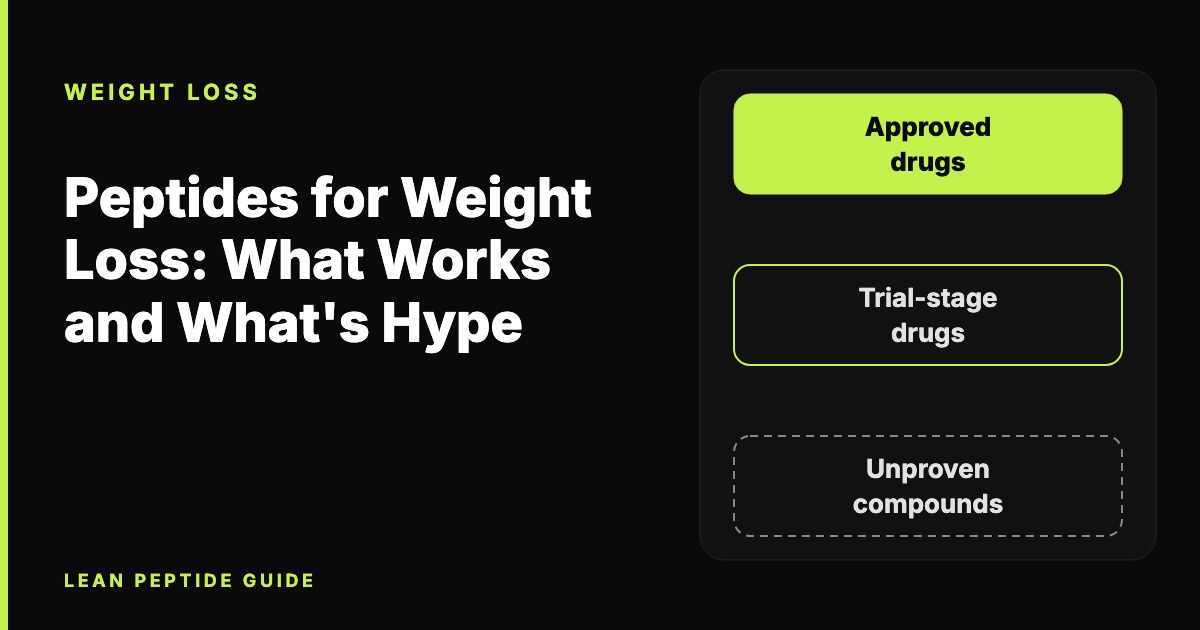
Notice what separates the first two rows from the rest. Large randomized trials, a regulatory review and a label that states who the drug is for and what the risks are all exist for the top rows. For the bottom rows, those things are missing.
Who the approved drugs are for, per the labels
The labels define populations. Wegovy and Zepbound are for adults (and, for Wegovy, ages 12 and older) with obesity, or overweight plus a weight-related condition, used with diet and physical activity. Zepbound's sleep apnea indication is for moderate to severe cases in adults with obesity.
The labels also say who should not use them. Both labels exclude people with a rare thyroid cancer type in their own or their family's history (or the inherited MEN 2 syndrome), and anyone with a serious allergy to the drug. Other named warnings include pancreas, gallbladder and kidney problems, and, on the Zepbound label, severe stomach and bowel effects, a pregnancy warning and a note about birth control pills. A prescriber weighs these against your history; this page cannot.
Also worth knowing: these are not short courses by design. The label schedules describe a gradual step-up and a maintenance phase, and the regain figures above show what the studies saw after stopping.
What a physician-supervised online route involves
If you want the approved drugs, a prescriber at your own clinic is one path, and the manufacturers run their own programs. Another is a telehealth service. Whoosh Wellness is the one we partner with, and we describe it only as Whoosh states it.
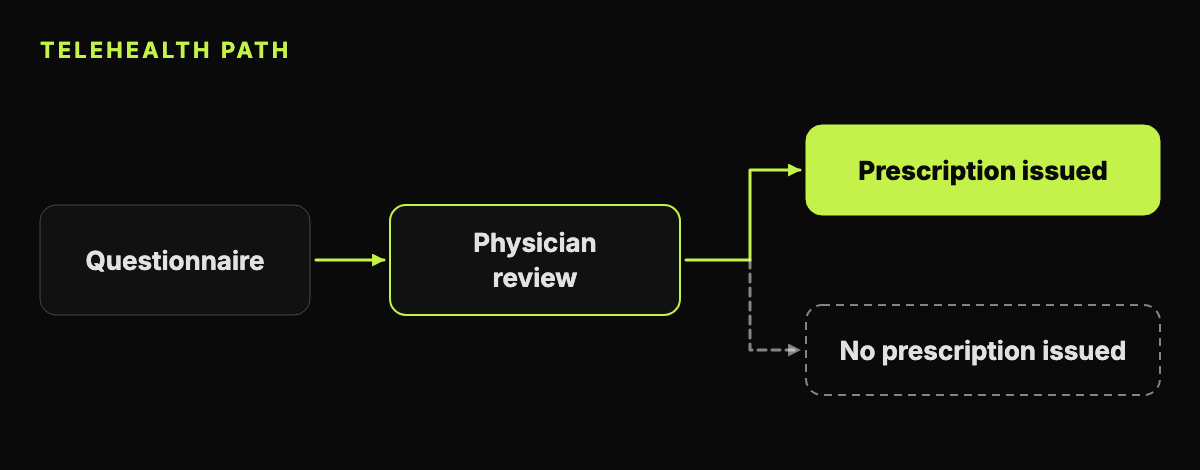
Whoosh calls itself a licensed telehealth platform with physician-prescribed protocols for weight management, recovery and longevity. As stated by Whoosh, the steps are a short intake questionnaire, an individual review by a licensed doctor who prescribes "if appropriate," shipping, and monthly check-ins. Whoosh's terms say completing the intake does not guarantee a prescription.
Be clear on one point: Whoosh lists compounded tirzepatide and compounded semaglutide, and compounded medications are not FDA-approved. FDA says it does not review them for safety, effectiveness or quality before marketing. They are not Wegovy or Zepbound, and the trial figures above do not carry over to them. Whoosh's own site says its compounded products are "not FDA-approved finished drugs." The detail is in our compounded GLP-1 explainer.
Some links on this page are affiliate links, which means we may earn a commission if you use them, and that does not change what we write about the evidence.
A licensed physician decides whether a prescription is appropriate, and the intake does not promise one.
For a side-by-side of the two main drugs, see tirzepatide vs semaglutide. For how Whoosh compares as a service, see our Whoosh Wellness review.
How to read claims about other "weight loss peptides"
Three habits help when a product page makes a claim.
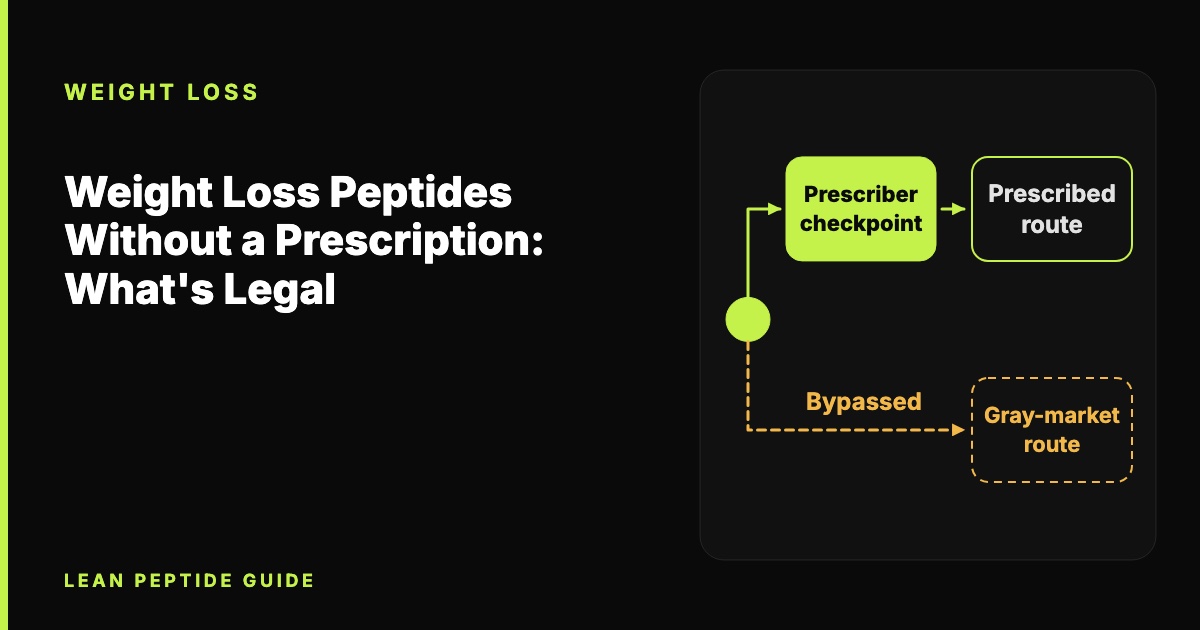
First, look for the regulatory status in plain words. An FDA-approved drug has a label. A compound sold as "research use only" has none, and FDA has stated, in a warning letter dated 2026-03-31 to Gram Peptides, that such labels do not change the fact that the products are intended as drugs for human use. We cover that in detail on the no-prescription page.
Second, check which evidence is being borrowed. A site that quotes STEP 1 or SURMOUNT-1 numbers while selling something else is using someone else's result. The trials tested specific branded drugs under supervision.
Third, watch for dosing instructions and syringe talk. FDA's warning letter of 2026-08-24 to Royal Peptides noted a seller pairing its vials with injection supplies, a "peptide guide" and a calculator. That is a marker of a product sold as a do-it-yourself drug, not as a prescribed one.
Lean mass is a separate subject. Weight lost on these drugs includes some lean tissue, and the proportion varies by study; our muscle on GLP-1 checklist covers what the guidance papers say.
Sources
- DailyMed: Wegovy injection label read 2026-10-06
- DailyMed: Wegovy injection and tablet label read 2026-10-06
- Novo Nordisk: Wegovy tablet approval news read 2026-10-06
- Lilly: Zepbound prescribing information read 2026-10-06
- Lilly: Mounjaro prescribing information read 2026-10-06
- DailyMed: Ozempic label read 2026-10-06
- PubMed abstract: STEP 1 read 2026-10-06
- PubMed abstract: SURMOUNT-1 read 2026-10-06
- Europe PMC record: SURMOUNT-5 read 2026-10-06
- PubMed abstracts: STEP 1 extension and SURMOUNT-4 read 2026-10-06
- Europe PMC record: TRIUMPH-1 read 2026-10-06
- Europe PMC record: TRIUMPH-2 read 2026-10-06
- Lilly Q2 2026 earnings release (SEC) read 2026-10-06
- FDA: concerns with unapproved GLP-1 drugs used for weight loss read 2026-10-06
- FDA: bulk drug substances that may present significant safety risks read 2026-10-06
- FDA warning letter: Gram Peptides read 2026-10-06
- FDA warning letter: Royal Peptides read 2026-10-06
- PubMed Central: AOD-9604 review read 2026-10-06
- PubMed Central: NNMT inhibitor review read 2026-10-06
- FDA: 503A bulk substances categories list read 2026-10-06
- Whoosh Wellness: FAQs, as stated by Whoosh read 2026-10-06
- Whoosh Wellness: terms and conditions read 2026-10-06
FAQ
Are GLP-1 drugs peptides?
Yes. Semaglutide and tirzepatide are peptide drugs. Their labels give molecular weights of 4113.58 (Wegovy) and 4813.53 (Zepbound). See peptides vs GLP-1 for how the terms relate.
Which peptides are FDA-approved for weight loss?
Semaglutide as Wegovy and tirzepatide as Zepbound are the two we found with weight-management labels, as listed above. Retatrutide, AOD-9604 and 5-Amino-1MQ are not FDA-approved.
Is retatrutide available yet?
Not as an approved drug. Lilly states it plans to submit an application to FDA in Q1 2027, and FDA says retatrutide cannot lawfully be compounded. Products sold online under that name are unapproved.
Do the trial results apply to compounded versions?
No. The trials tested the branded, approved drugs with lifestyle intervention. Compounded versions are not FDA-approved, and FDA does not review them for safety, effectiveness or quality before they are marketed.
Does 5-Amino-1MQ work in people?
We found no human trial. A 2024 review states that none has been reported for this class, and the supportive findings are from mice.
Can a peptide supplement replace a prescription drug?
We found no FDA statement approving any over-the-counter peptide product for weight loss, and the evidence tables above come from prescription drugs. Our no-prescription guide goes through the options.
What happens after someone stops the approved drugs?
In the STEP 1 extension, participants regained 11.6 percentage points of lost weight on average in the year after withdrawal. Plans for stopping are a conversation with a prescriber.
Not medical advice. See the medical disclaimer.