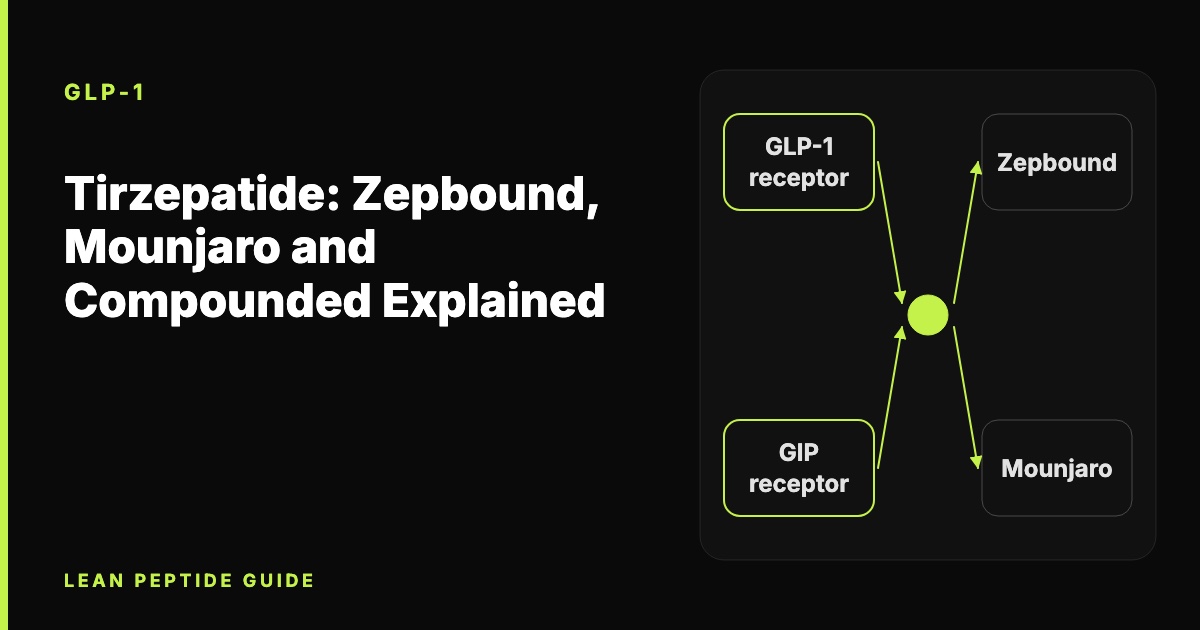
Quick answer: Tirzepatide is a once-weekly injection that activates both the GIP and GLP-1 receptors. It is FDA-approved as Zepbound, for weight management and for obstructive sleep apnea in adults with obesity, and as Mounjaro, for type 2 diabetes. Compounded tirzepatide is not FDA-approved. Trial results belong to the approved brands, and a licensed physician decides whether any prescription is appropriate.
- Type
GIP and GLP-1 receptor agonist; molecular weight 4813.53 Da per the Zepbound label
- Form
Once-weekly injection (Zepbound, Mounjaro); Whoosh states microdose injection, full-dose injection and liposomal tablets
- FDA status
Zepbound and Mounjaro are approved; compounded versions are not FDA-approved
- Whoosh offers it
Yes, compounded, as stated by Whoosh
Overview
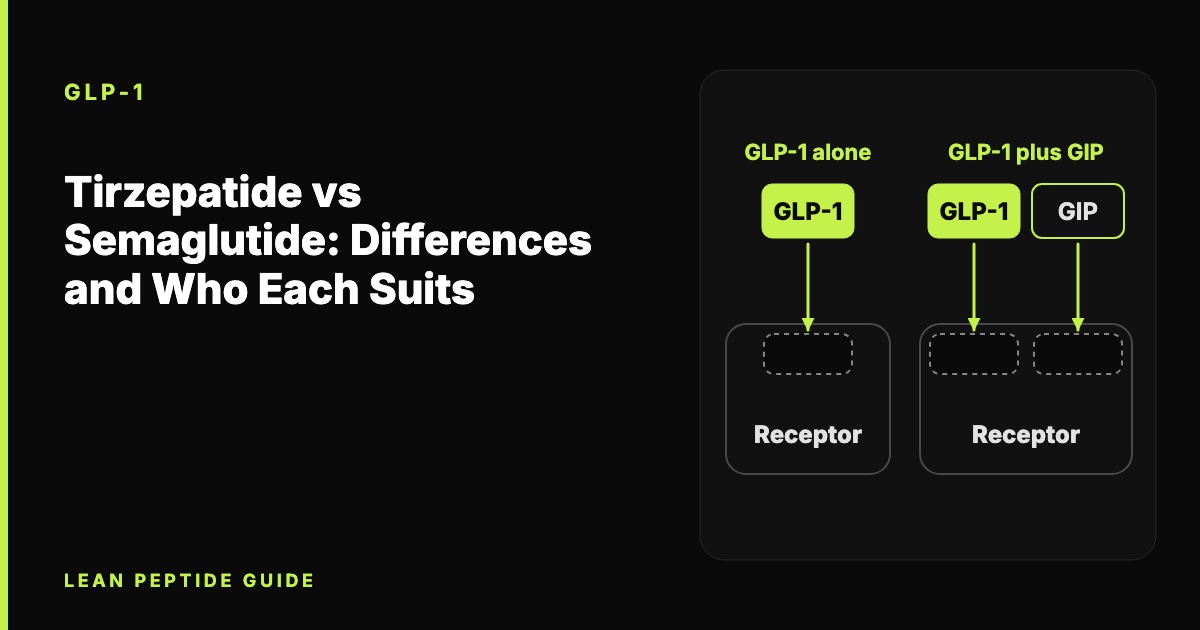
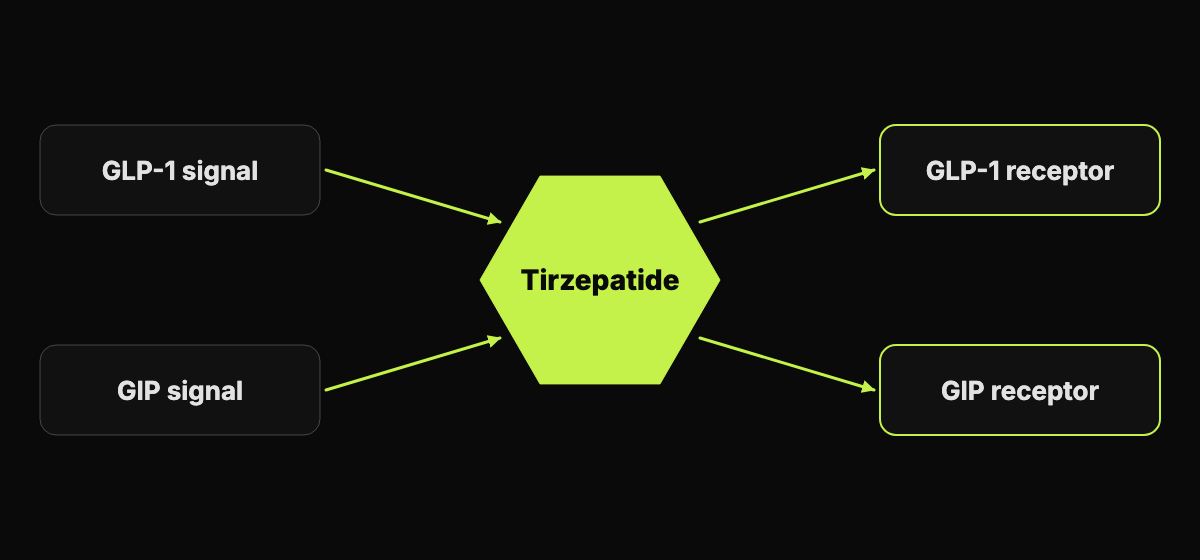
Tirzepatide acts on two hormone receptors, GIP and GLP-1, where semaglutide acts on GLP-1 alone. The Zepbound label describes it as an agonist at both. The same label says it is based on the GIP sequence, with modified amino acids and a fatty-acid side chain, which is why it is described as a peptide drug. Zepbound and Mounjaro contain the same active ingredient but carry different labeled uses, and Zepbound's label says not to combine it with other tirzepatide products or any GLP-1 receptor agonist.
For the side-by-side with semaglutide, see our tirzepatide versus semaglutide comparison. Our semaglutide profile covers the other drug.
Status
- Zepbound. The label states it is for adults, with a reduced-calorie diet and more physical activity, to reduce excess body weight and maintain the reduction long term, in adults with obesity or with overweight plus a weight-related condition. It also has an indication for moderate to severe obstructive sleep apnea in adults with obesity.
- Mounjaro. Labeled for blood sugar control in type 2 diabetes in adults and in children 10 and older, and to reduce cardiovascular event risk in adults with type 2 diabetes at high cardiovascular risk. The label was revised in August 2026.
We print no dose schedules, because each approved label has its own and a prescriber sets it.
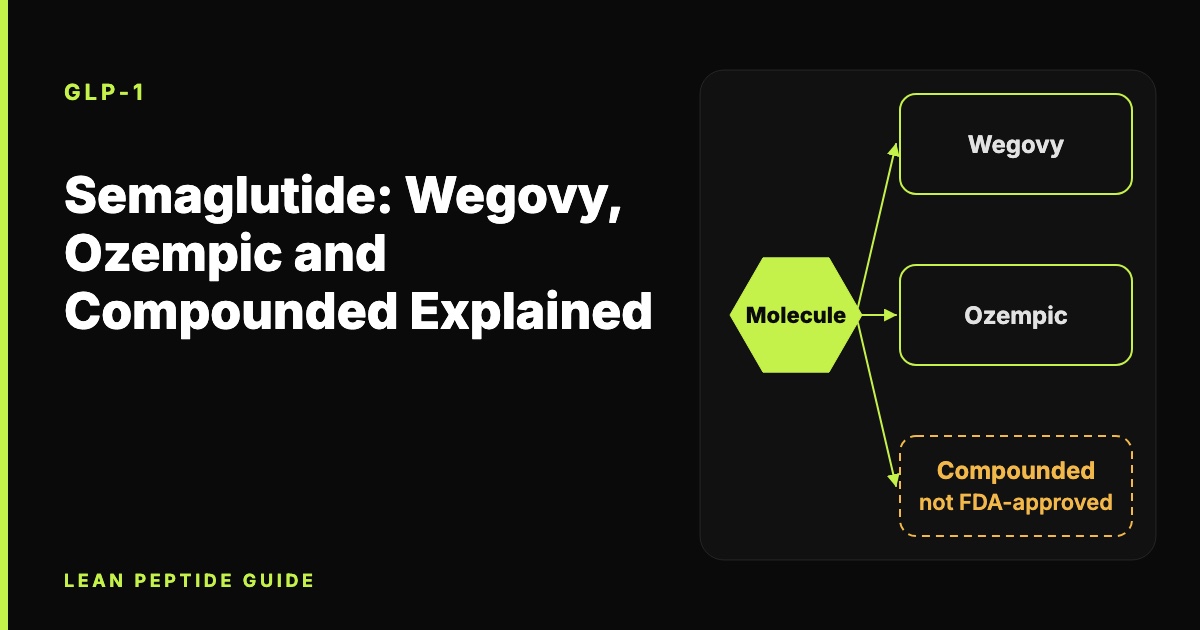
Compounded tirzepatide is not FDA-approved. FDA states that these versions are not reviewed for safety, effectiveness or quality before they are marketed. FDA first listed a tirzepatide shortage on 2022-12-15, removed it 2024-10-02, and issued a new determination that it was resolved, dated 2024-12-19. FDA also floated a change to the 503B bulks list on 2026-04-30 that would cover tirzepatide; as we read it, that remains a proposal. Our guide to compounded GLP-1s explains the 503A and 503B terms.
Evidence
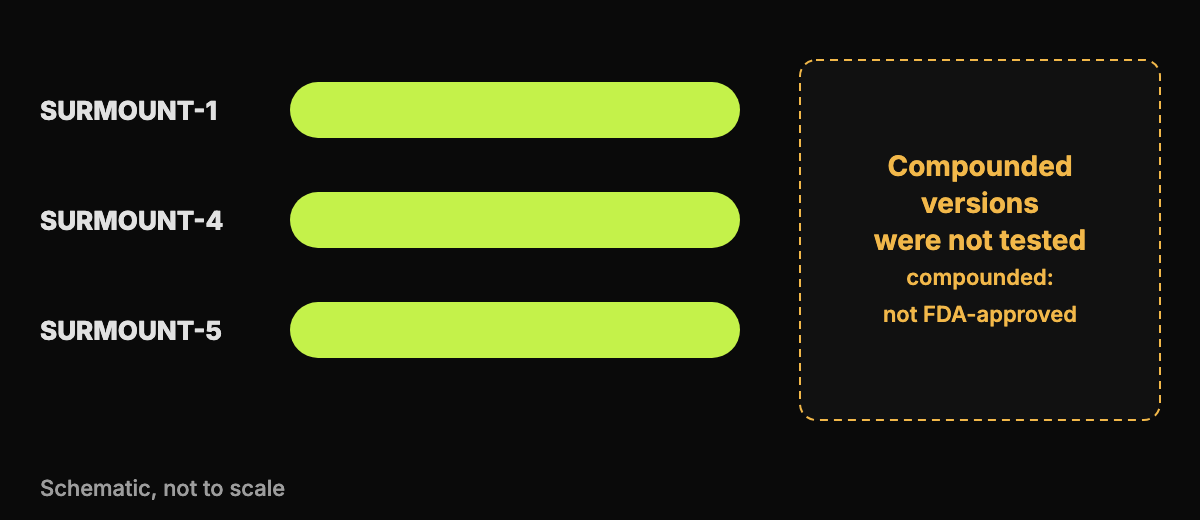
SURMOUNT-1 (Jastreboff and colleagues, New England Journal of Medicine, 2022) enrolled 2,539 adults with a BMI of 30 or more, or 27 or more with a complication, and no diabetes. They received tirzepatide 5, 10 or 15 mg or placebo, alongside lifestyle intervention, for 72 weeks including a 20-week escalation. Mean weight change at week 72 was -15.0 percent at 5 mg, -19.5 percent at 10 mg and -20.9 percent at 15 mg, against -3.1 percent with placebo. At 15 mg, 91 percent reached a loss of 5 percent or more.
SURMOUNT-5 (New England Journal of Medicine, 2025) compared the two brand drugs head to head. It was an open-label phase 3b trial of 751 adults with obesity and no type 2 diabetes, randomized to the maximum tolerated dose of tirzepatide or semaglutide for 72 weeks. Mean weight change was -20.2 percent with tirzepatide and -13.7 percent with semaglutide (P<0.001), and waist circumference fell 18.4 cm against 13.0 cm. The authors described gastrointestinal events as mostly mild to moderate and clustered during dose escalation. Open-label means participants and investigators knew which drug was given.
A scan substudy of SURMOUNT-1 in 160 participants reported lean mass down 10.9 percent with tirzepatide at week 72 against 2.6 percent with placebo. Its abstract states that about 75 percent of the weight lost was fat mass and about 25 percent lean mass, for both groups. See our page on muscle and GLP-1 drugs for how to read lean mass numbers.
SURMOUNT-4 looked at stopping. After a 36-week lead-in, people who continued tirzepatide changed by -5.5 percent from week 36 to 88, while those switched to placebo changed by +14.0 percent.
All of these are trials of the brand drugs, used as labeled under supervision. None of them studied compounded products.
Side effects
The Zepbound label has a boxed warning: in rats, tirzepatide causes thyroid C-cell tumors. The label lists as contraindications a personal or family history of medullary thyroid carcinoma, or of MEN 2.
Named warnings include severe gastrointestinal reactions, acute kidney injury from fluid loss, gallbladder disease, acute pancreatitis, low blood sugar when used with insulin or sulfonylureas, reduced effectiveness of oral contraceptives because of delayed stomach emptying, and fetal harm. Common adverse reactions (5 percent or more) include nausea, diarrhea, vomiting, constipation, abdominal pain, indigestion, injection site reactions, fatigue, hypersensitivity reactions, belching, hair loss and reflux. Trial-reported ranges across doses were roughly 25 to 28 percent for nausea and 19 to 23 percent for diarrhea.
As of 2026-05-31, FDA had received more than 730 adverse event reports for compounded tirzepatide. Our safety overview lays out risk by source.
Access
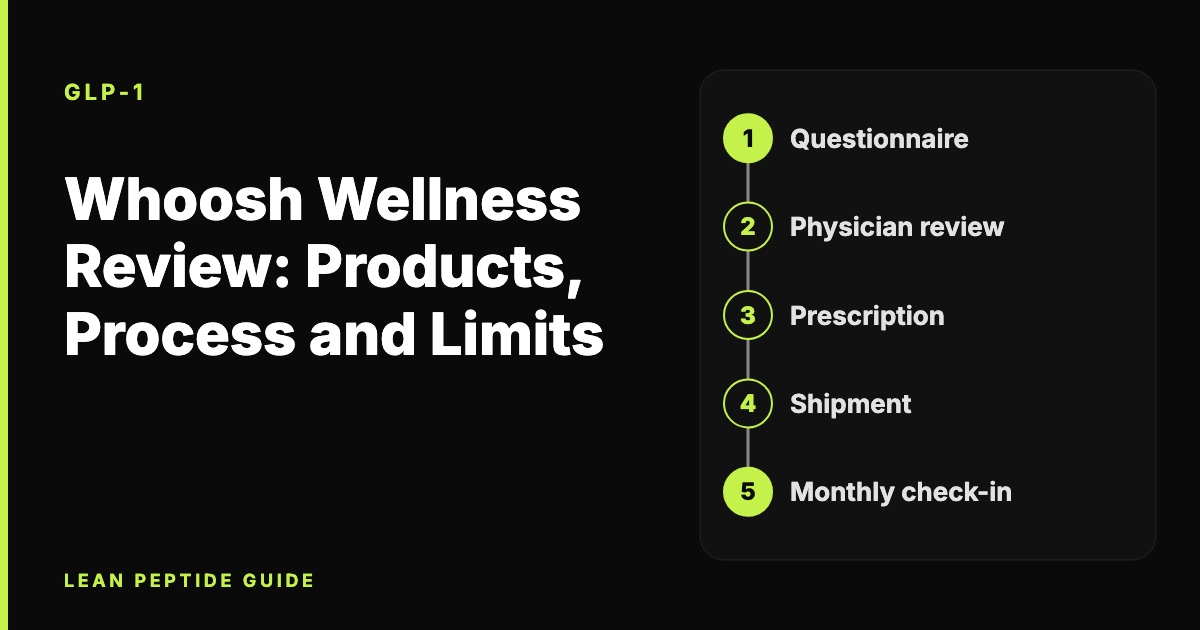
Zepbound and Mounjaro are prescription medicines. Whoosh Wellness states that it offers compounded tirzepatide as a microdose injection, a full-dose injection or liposomal tablets (read 2026-10-06). Disclosure: the link below is an affiliate link, so we may be paid when someone signs up through it.
In this process a licensed physician decides, per Whoosh, and no outcome is assured. See our Whoosh Wellness review for details.
Sources
- Zepbound prescribing information, Lilly read 2026-10-06
- Zepbound label, FDA read 2026-10-06
- Mounjaro prescribing information, Lilly read 2026-10-06
- SURMOUNT-1 abstract (PubMed 35658024) read 2026-10-06
- SURMOUNT-5 record (PMID 40353578), Europe PMC read 2026-10-06
- SURMOUNT-1 body composition substudy (PubMed 39996356) read 2026-10-06
- SURMOUNT-4 abstract (PubMed 38078870) read 2026-10-06
- FDA: concerns with unapproved GLP-1 drugs used for weight loss read 2026-10-06
- FDA decision memo on the tirzepatide shortage read 2026-10-06
- FDA proposal on the 503B bulks list (2026-04-30) read 2026-10-06
- Whoosh Wellness: peptide therapy page, as stated by Whoosh read 2026-10-06
FAQ
What is the difference between Zepbound and Mounjaro?
They share the active ingredient. Zepbound is labeled for weight management and sleep apnea in adults with obesity, and Mounjaro for type 2 diabetes. A prescriber picks the product.
Does tirzepatide work better than semaglutide?
In SURMOUNT-5, an open-label trial of the two brand drugs in 751 adults, mean weight change was larger with tirzepatide. That result applies to those approved products and that population, not to compounded versions.
What is the status of compounded tirzepatide?
It is not FDA-approved, and FDA says compounded drugs are not reviewed for safety, effectiveness or quality before marketing.
What does the boxed warning say?
In rats, tirzepatide caused thyroid C-cell tumors. The label lists a personal or family history of medullary thyroid carcinoma, or MEN 2, as contraindications.
Not medical advice. See the medical disclaimer.