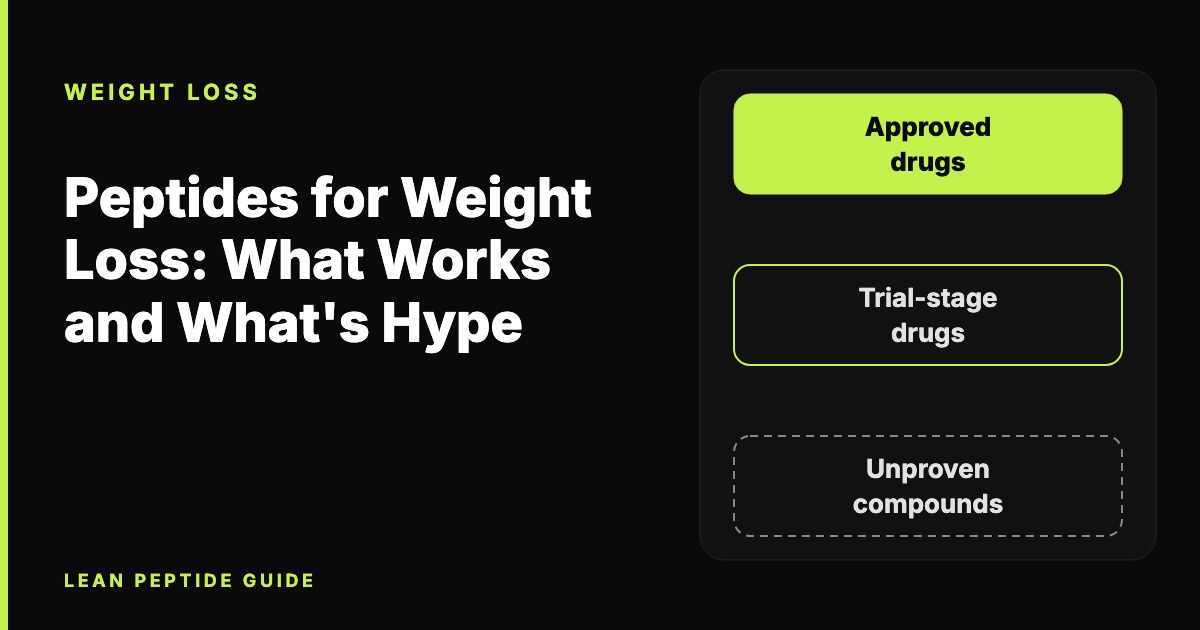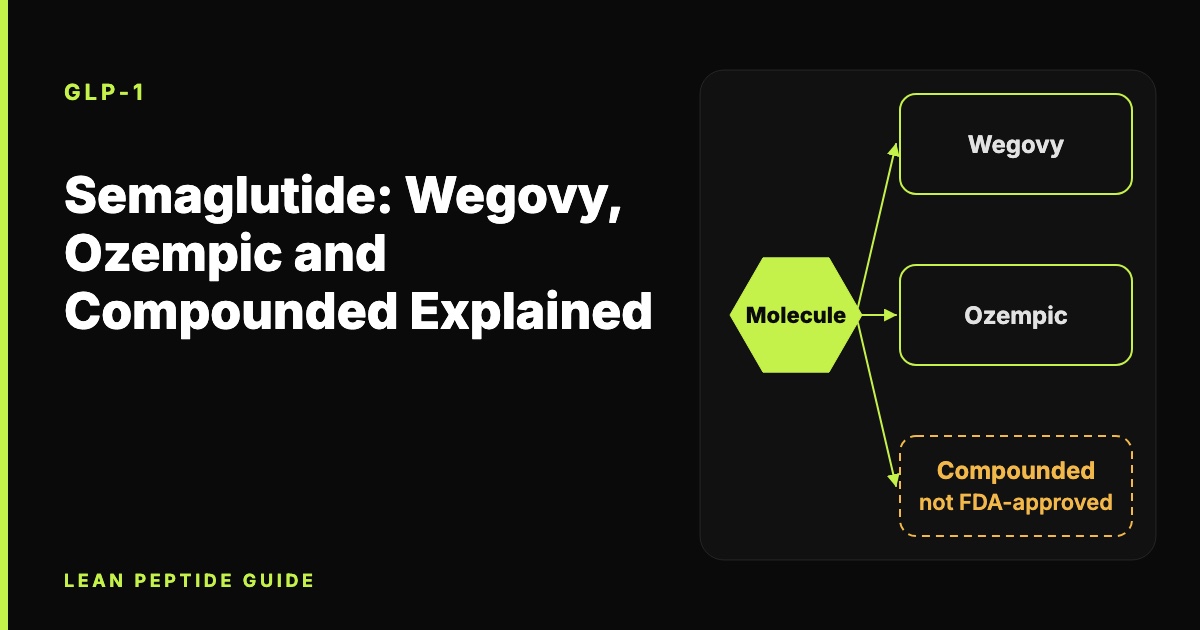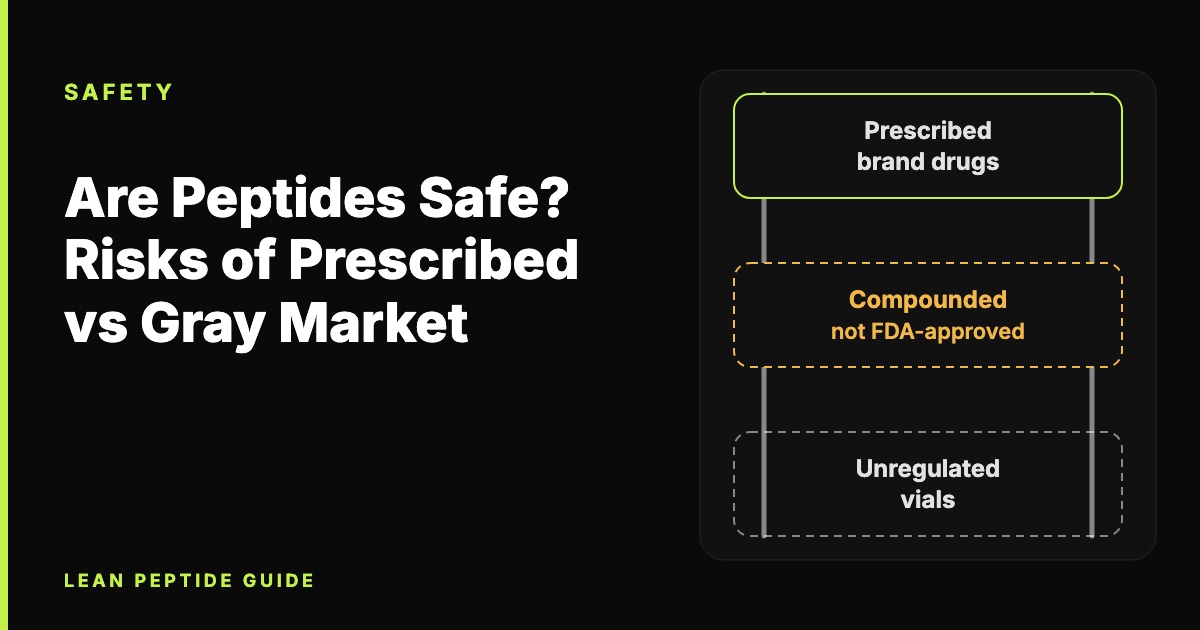
Quick answer: There is no single answer, because "peptides" covers approved drugs, compounded preparations and unregulated vials. Approved drugs such as Wegovy and Zepbound carry boxed warnings, contraindications and common digestive side effects, yet each comes with a label and a prescriber. FDA has documented dosing errors, counterfeits and unapproved products on the gray market, where nobody checks the contents. Risk follows the source, the dose and the supervision.
Safety questions about peptides are really three questions: what is in the vial, who chose the dose, and who is watching for problems. The sections below take them in order, drawing on FDA labels and FDA alerts. We give dates because the situation has changed more than once in the past few years.
Why the source matters more than the word "peptide"
Insulin is a peptide. So is semaglutide. So is a compound that only a seller has ever described. The word does not predict the risk. What does is whether a manufacturer ran trials and earned a label, whether a pharmacy dispensed against a prescription, and whether someone follows up. You can read how the terms differ in peptides vs GLP-1.
The approved drugs: what the labels warn about
Approved does not mean without risk. It means FDA reviewed the evidence and wrote the risks down. Here is what the labels say, in our summary.
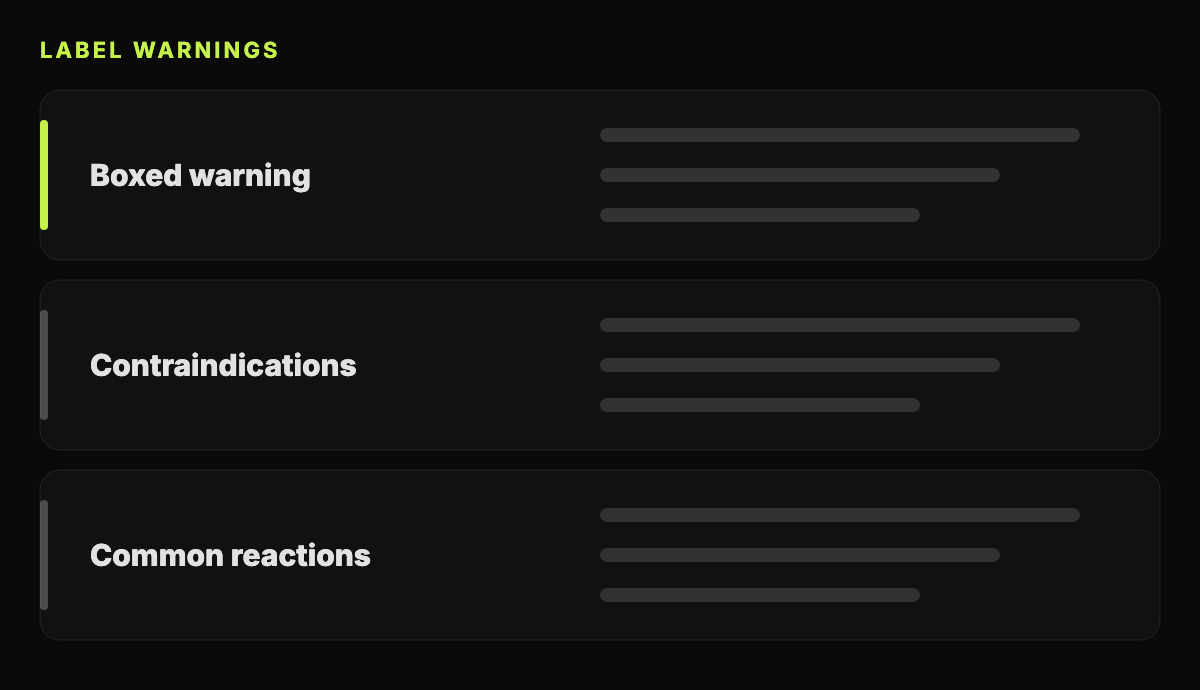
Boxed warning. The Wegovy label says semaglutide caused thyroid C-cell tumors in rodents at clinically relevant exposures, and that human relevance was not determined. The Zepbound label states the same finding for tirzepatide in rats. Both labels list a personal or family history of medullary thyroid carcinoma, or of Multiple Endocrine Neoplasia syndrome type 2, as a contraindication.
Other contraindication. The Wegovy and Ozempic labels list known serious hypersensitivity to semaglutide or its ingredients.
Warnings named on the Wegovy label. Pancreatitis, gallbladder disease and kidney injury, a low-blood-sugar risk for people who also take insulin or sulfonylureas, and a note telling prescribers to monitor for suicidal behavior and ideation.
Warnings named on the Zepbound label. Severe gastrointestinal reactions, acute kidney injury from volume depletion, gallbladder disease, acute pancreatitis, low blood sugar with insulin or sulfonylureas, reduced effectiveness of oral contraceptives because of delayed gastric emptying, and fetal harm. The label says to discontinue if pregnancy is recognized.
Common reactions. For Wegovy injection, the label lists nausea in 44% of adults, diarrhea in 30%, vomiting in 24% and constipation in 24%. For Zepbound, the label reports ranges across doses of about 25-29% for nausea, 19-23% for diarrhea, 8-13% for vomiting and 11-17% for constipation. The Wegovy tablet label reports serious gastrointestinal reactions in 2% of tablet users versus 0% on placebo.
We did not capture every warning on each label. The full text is on DailyMed and in Lilly's prescribing information, and the label is the document to read with your prescriber. These figures describe the branded, approved products as tested in trials, and they do not describe other versions.
Who should not use GLP-1 drugs, per the labels
Labels, not websites, set the exclusions. According to the labels we read:
- Wegovy and Zepbound are contraindicated for anyone whose own or relatives' history includes medullary thyroid carcinoma or MEN 2.
- Anyone with a known serious hypersensitivity to the drug or its ingredients is excluded.
- Zepbound's label warns about fetal harm, so pregnancy is a discussion for the prescriber.
- People using insulin or sulfonylureas face a low-blood-sugar warning on both labels.
- People on oral contraceptives get a specific warning on the Zepbound label.
- Anyone with a history of pancreatitis, gallbladder problems, kidney problems or suicidal thoughts should expect the prescriber to ask about it, since those appear among the warnings.
Only a clinician can weigh these against your history. If a seller's questionnaire never asks about any of them, that tells you something about the seller.
What FDA documented on compounded and unapproved GLP-1 products
On compounded drugs, FDA's position is that they are not FDA-approved and that safety, effectiveness and quality go unchecked before marketing. FDA's compounding Q&A, dated 2025-09-16, adds that poor compounding can cause contamination or wrong strength.
The dosing-error alert is the clearest example. FDA's alert dated 2024-07-26 describes patients who drew 5 to 20 times the intended dose from multi-dose vials. It points to confusion among mL, mg and "units," with one example of 50 units drawn instead of 5 on a U-100 syringe, and to errors when providers converted doses. Events included nausea, vomiting, abdominal pain, fainting, dehydration, pancreatitis and gallstones, and some people were hospitalized.
FDA's page on unapproved GLP-1 drugs, current as of 2026-10-01, repeats the concern: it reports adverse events from patient self-dosing mistakes and provider miscalculation, with some patients receiving doses above the approved label. It also says multi-dose vials should be discarded 28 days after first use. As of 2026-05-31, it counts 990 adverse event reports for compounded semaglutide and more than 730 for compounded tirzepatide. It also states that semaglutide salt forms (sodium, acetate) are not approved, and that retatrutide and cagrilintide cannot lawfully be compounded.
This is not a claim that every compounded product is dangerous. It is a statement of what FDA has recorded, and of what FDA does not do: it does not pre-approve the product.
Counterfeits, fraudulent pharmacies and research-use vials
The same FDA page says counterfeit Ozempic has appeared in the US supply, some pharmacies have used false credentials, and some sellers apply a "research" or "not for human consumption" label yet ship the product with instructions written for people. It lists red flags: prices that seem too good to be true, damaged packaging and no oversight by a licensed physician.
FDA's warning letters add detail. In a letter dated 2026-03-31, FDA told Gram Peptides that a "research use only" label leaves the intended human use of the products unchanged. A letter dated 2026-08-24 to Peak Performance Peptides said the research-use disclaimers did not defeat the intended-use findings, and cited the fact that injectables bypass the body's usual defenses. For more on the legal side, see our page on buying without a prescription.
Other peptides: what FDA has said
FDA's page on bulk drug substances that may present significant safety risks lists FDA's stated concerns for several peptides sold online. It cites immunogenicity and serious adverse events for ipamorelin, including death when given intravenously, and elevated heart rate and a vasodilatory reaction for CJC-1295. It raises immunogenicity concerns and a lack of safety information for BPC-157 and AOD-9604. We avoid assigning category labels because the FDA pages we read were not fully consistent on ipamorelin.
For BPC-157, an FDA briefing document dated 2026-05-11, prepared for a July 2026 advisory committee, weighs against placing it on the bulks list for 503A compounding. That is FDA staff's recommendation to the committee, not a final decision, and we did not find the committee's outcome.
None of these are approved weight-loss drugs. Retatrutide, which is in late-stage trials, is a distinct case: published trials report gastrointestinal effects as the most frequent, and TRIUMPH-2 reported diarrhea in 27-34% versus 13% with placebo, with hypotension and dysesthesia more frequent. It remains not FDA-approved.
A risk-by-source table
This table places each source type next to its oversight and the documented risks. "Documented" means a label, an FDA statement or a trial abstract we cite above.
| Source | Who oversees it | Documented risks | Where documented |
|---|---|---|---|
| Approved brand drug, prescribed (Wegovy, Zepbound) | FDA review; prescriber; pharmacy | Boxed thyroid warning; pancreatitis, gallbladder, kidney warnings; frequent digestive effects | Wegovy and Zepbound labels |
| Compounded drug, prescribed | A prescriber and a compounding pharmacy; FDA does not review it before marketing | Not FDA-approved; contamination or wrong strength possible; dosing-error events recorded | FDA compounding Q&A; FDA alerts of 2024-07-26 and 2026-10-01 |
| Counterfeit or fraudulent pharmacy | Nobody | Counterfeit Ozempic in the US supply; false credentials | FDA concerns page |
| "Research use only" vial | Nobody checks contents | Unapproved new drug where marketed for human use; no label; self-directed dosing | FDA warning letters, 2024-12-10, 2026-03-31, 2026-08-24 |
| Over-the-counter "weight loss" supplement | Not reviewed as a drug | Weight-loss products can hide undisclosed drugs; example is sibutramine | FDA hidden ingredients page |
| Other online peptides (ipamorelin, CJC-1295, BPC-157) | None as drugs | FDA-stated safety concerns including immunogenicity | FDA bulk substances safety page |
The pattern is consistent. Moving down the table, the number of people who can check the product and your dose gets smaller.
A prescribed route, and what it does and does not change
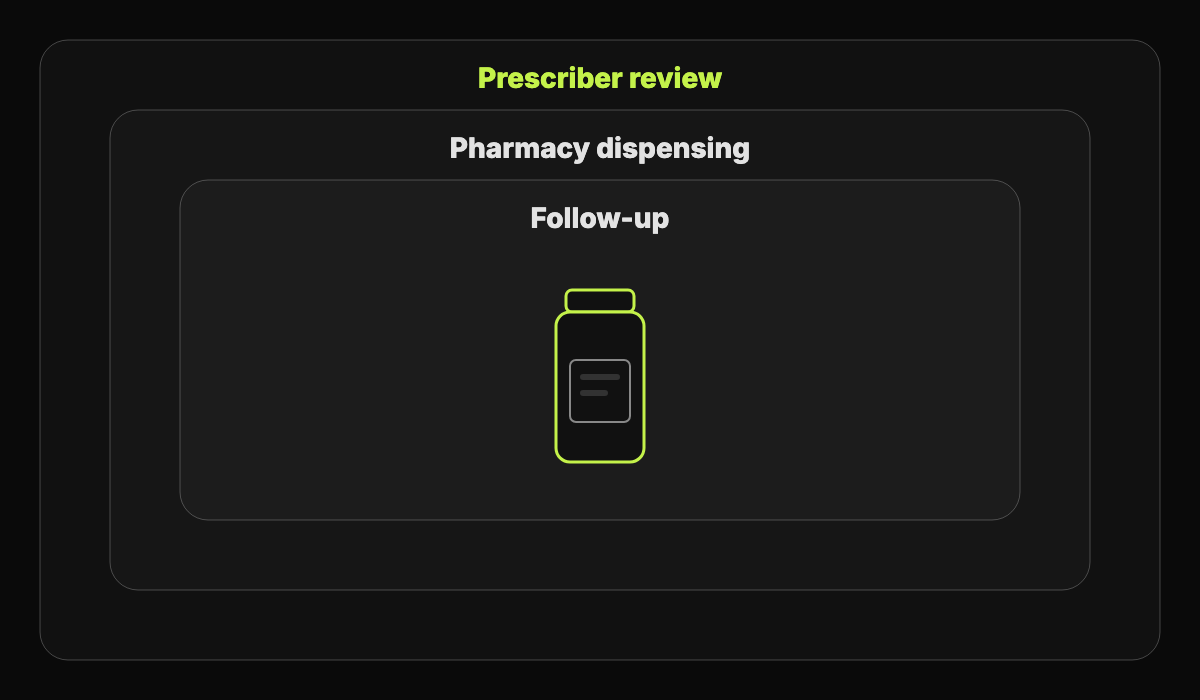
If you want a supervised path, a prescriber is the starting point, whether at your own clinic or through telehealth. Whoosh Wellness is the telehealth partner we describe. As stated by Whoosh, a licensed doctor reviews each intake individually and prescribes "if appropriate," and monthly check-ins follow. Whoosh's terms say its service is not a substitute for primary care, that you should call 911 in an emergency, and that completing intake does not guarantee a prescription.
Whoosh lists compounded tirzepatide and compounded semaglutide. These are not FDA-approved, and Whoosh's own site says so. A prescriber, a pharmacy and check-ins reduce some risks, such as an unknown product and unsupervised dosing. They do not turn a compounded drug into an approved one. We explain the distinction in our compounded GLP-1 explainer.
Our links to Whoosh are affiliate links, and we may earn a commission if you use them.
Here, a licensed physician decides whether any prescription fits you, so no outcome is assured.
Beyond the drug: other safety questions
Lean mass is one. In the SURMOUNT-1 body composition substudy of tirzepatide, with 160 participants, the abstract states that about 75% of weight lost was fat mass and about 25% lean mass, and that the split was similar for placebo. Lean mass measured by DXA is not the same as muscle. Our muscle on GLP-1 checklist covers the guidance papers.
Regain is another. In SURMOUNT-4, participants who switched to placebo had a mean change of +14.0% from week 36 to week 88. It is not a safety event, but plan for it with a prescriber.
Finally, interactions. Several label warnings involve other medicines, such as insulin, sulfonylureas and oral contraceptives. Tell any prescriber everything you take, including supplements.
Sources
- DailyMed: Wegovy injection label read 2026-10-06
- DailyMed: Wegovy injection and tablet label read 2026-10-06
- DailyMed: Ozempic label read 2026-10-06
- Lilly: Zepbound prescribing information read 2026-10-06
- FDA: concerns with unapproved GLP-1 drugs used for weight loss read 2026-10-06
- FDA: alert on dosing errors with compounded semaglutide read 2026-10-06
- FDA: compounding and FDA questions and answers read 2026-10-06
- FDA: compounding risk alerts read 2026-10-06
- FDA warning letter: Gram Peptides read 2026-10-06
- FDA warning letter: Summit Research Peptides read 2026-10-06
- FDA warning letter: Peak Performance Peptides read 2026-10-06
- FDA: avoiding products contaminated with hidden ingredients read 2026-10-06
- FDA: bulk drug substances that may present significant safety risks read 2026-10-06
- FDA: briefing document on BPC-157 read 2026-10-06
- Europe PMC record: TRIUMPH-2 read 2026-10-06
- PubMed abstract: SURMOUNT-1 body composition substudy read 2026-10-06
- PubMed abstracts: SURMOUNT-4 and related read 2026-10-06
- Whoosh Wellness: FAQs, as stated by Whoosh read 2026-10-06
- Whoosh Wellness: terms and conditions read 2026-10-06
FAQ
Are peptides safe?
It depends on which one and where it comes from. Approved drugs carry documented warnings and are prescribed; unapproved products have no label and no FDA review, and FDA has issued warning letters about several sellers.
Is a compounded GLP-1 less safe than the brand?
We cannot rank them. What FDA states is that compounded drugs are not FDA-approved and are not reviewed for safety, effectiveness or quality before marketing, and that it recorded dosing-error events.
What are the most common side effects of Wegovy and Zepbound?
Digestive ones: nausea, diarrhea, vomiting and constipation, with the percentages above from each label. Your prescriber can explain what to watch for.
Who should not take GLP-1 drugs?
The labels exclude people with a personal or family history of medullary thyroid carcinoma or MEN 2, and people with serious hypersensitivity to the drug. Pregnancy and other conditions call for the prescriber's judgment.
Are research peptides safe to inject?
FDA has said such vials are unapproved new drugs where marketed for human use, and warns that injectables bypass the body's usual defenses. No regulator checks the contents. See our weight loss guide for what is approved.
Does a telehealth prescription make a drug safer?
A prescriber, pharmacy and follow-up add oversight. Whoosh states a licensed doctor reviews each intake, but compounded products remain not FDA-approved, so oversight does not equal approval.
When should I call a clinician?
Ask your prescriber which symptoms they want to hear about, since label warnings include pancreatitis, gallbladder disease and kidney injury. In an emergency, call 911, as Whoosh's own terms also state.
Not medical advice. See the medical disclaimer.