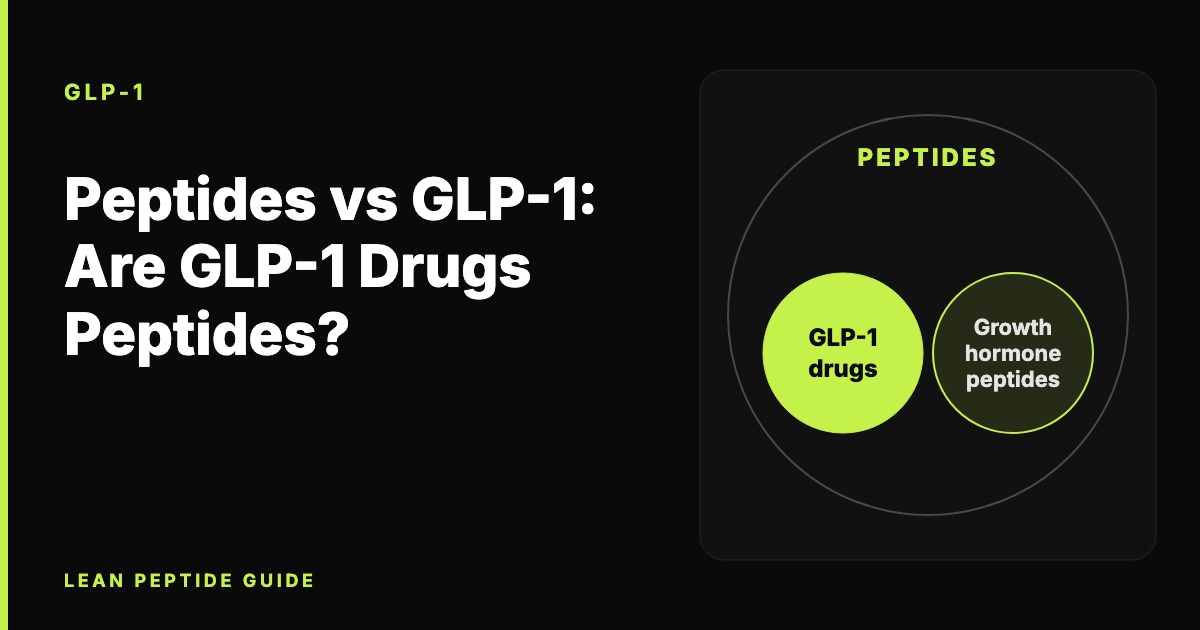
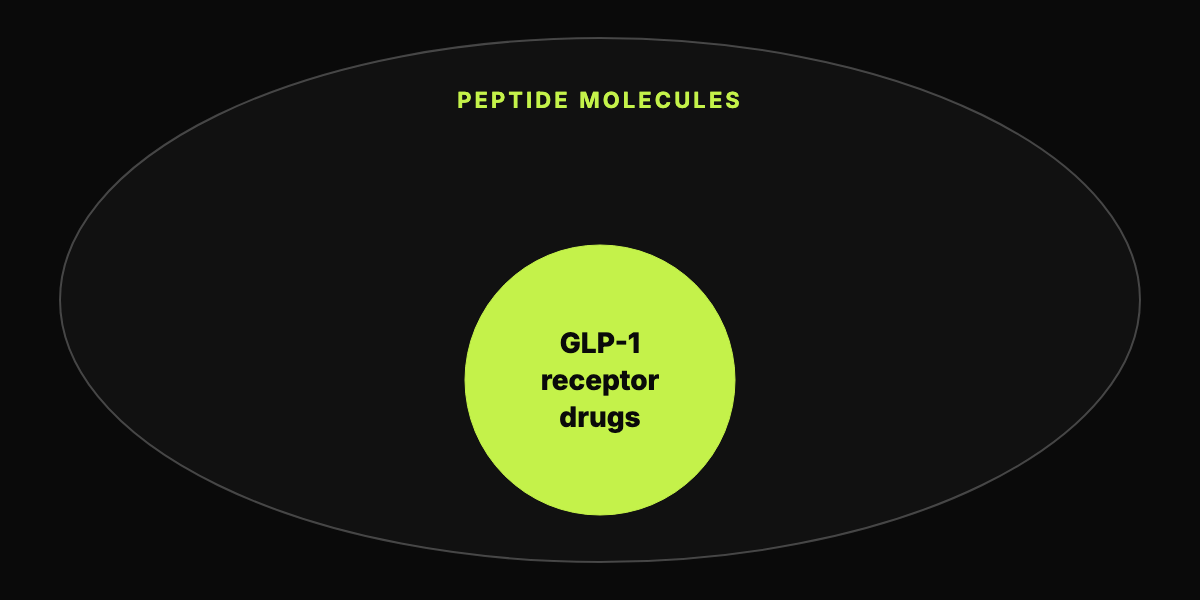
Quick answer: Yes, GLP-1 drugs are peptides. Semaglutide and tirzepatide are chemically modified chains of amino acids, and their labels give molecular weights of 4113.58 and 4813.53. But "peptide" is a size description, not a drug class. GLP-1 drugs are one family inside it, approved after large trials. Growth hormone peptides such as sermorelin work through a different system and have a very different regulatory history.
This confusion drives a lot of searches, and sellers benefit from it. A product page that says "peptides" can mean an approved prescription drug, a compounded preparation, or a vial with no approval at all. Below we separate the terms, name what each one is approved for, and cite the labels and reviews we used.
"Peptide" is a size, not a category
A peptide is a chain of amino acids. Shorter chains are called peptides and longer, folded ones are called proteins, though the boundary is a convention. Insulin is a peptide hormone. So is GLP-1, the gut hormone that GLP-1 drugs imitate. So are many compounds that exist only as lab products.
Calling something a peptide therefore tells you how big the molecule is and little else. It says nothing about whether it was tested in people, who regulates it, or whether it does what a seller claims. A useful way to hold it: "peptide" is like "vehicle." A bicycle and a freight truck are both vehicles, and nobody would assume one can do the other's job.
GLP-1 drugs are peptides
GLP-1 stands for glucagon-like peptide-1, a hormone released from the gut after eating. A GLP-1 receptor agonist is a drug that binds and activates the same receptor. The category includes:
- Semaglutide. The Ozempic label describes it as a GLP-1 receptor agonist that selectively binds and activates the GLP-1 receptor, with a molecular weight of 4113.58 g/mol on the Wegovy label. The label describes modifications to the natural GLP-1 sequence that make it more stable and let a fatty acid attach.
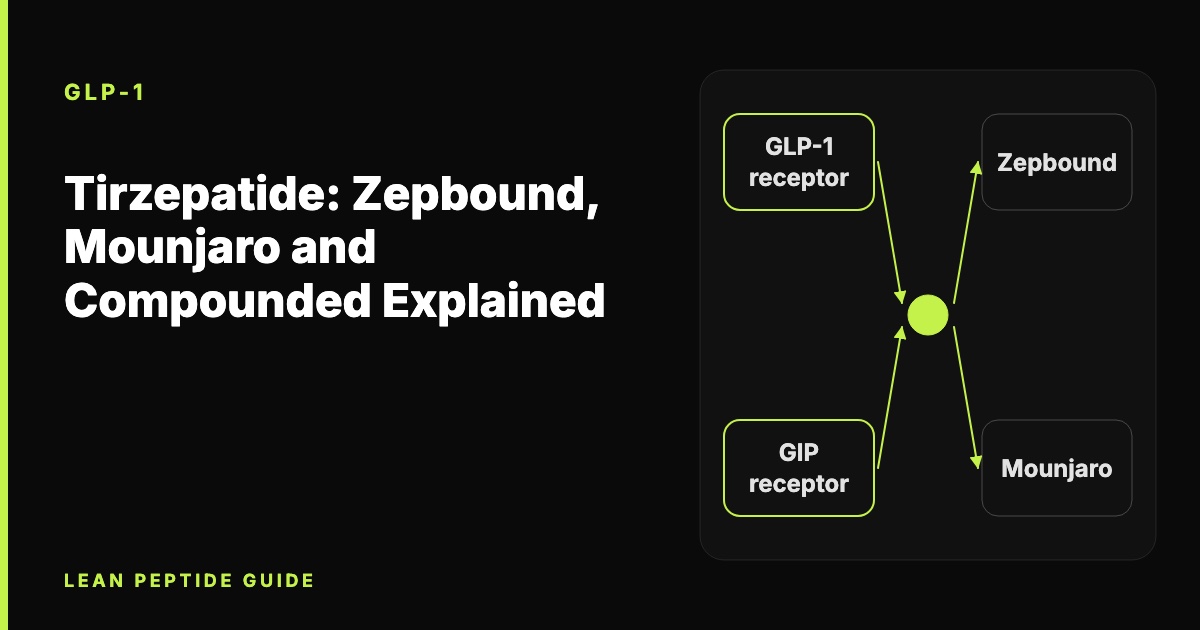
- Tirzepatide. The Zepbound label describes it as an agonist at the GIP and GLP-1 receptors, with a molecular weight of 4813.53 Da. The label says its structure starts from the GIP sequence and attaches a fatty-acid side chain.
So yes, both are peptide drugs. And because tirzepatide targets two receptors, people sometimes call it a "dual agonist" rather than a GLP-1 drug in the strict sense. Many sources still group it with GLP-1 drugs, and so do we.
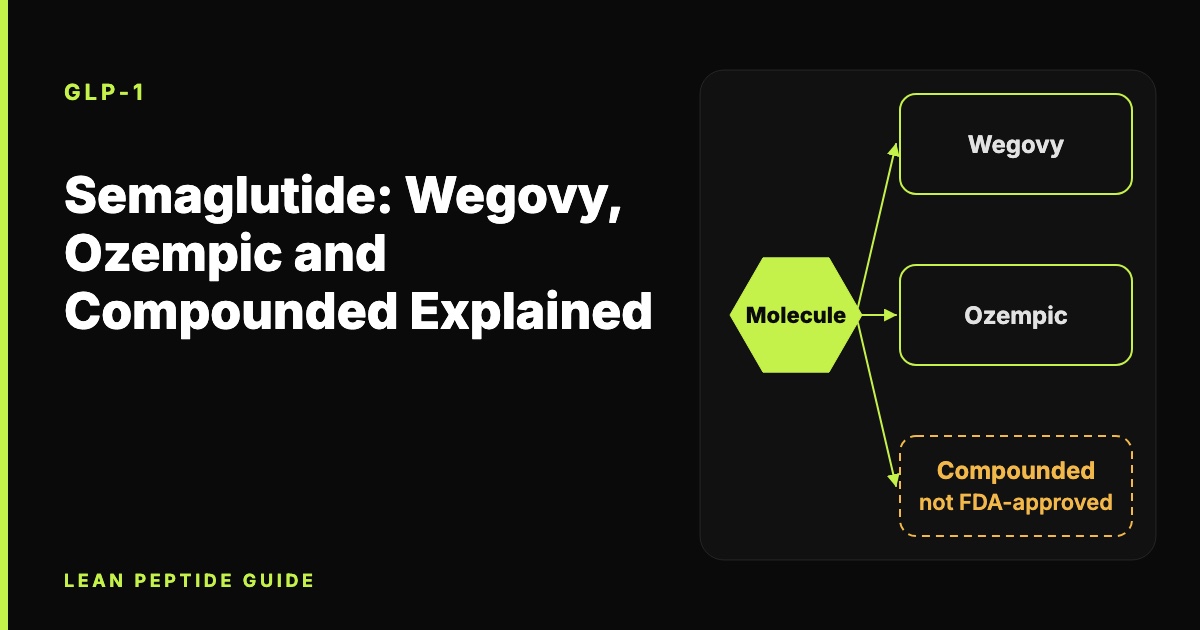
What each is approved for depends on the brand. Wegovy and Zepbound are the weight-management brands; Ozempic, Rybelsus and Mounjaro carry type 2 diabetes labels. Our guide to peptides for weight loss lists the label wording and trial results, and tirzepatide vs semaglutide compares the two.
How growth hormone peptides differ
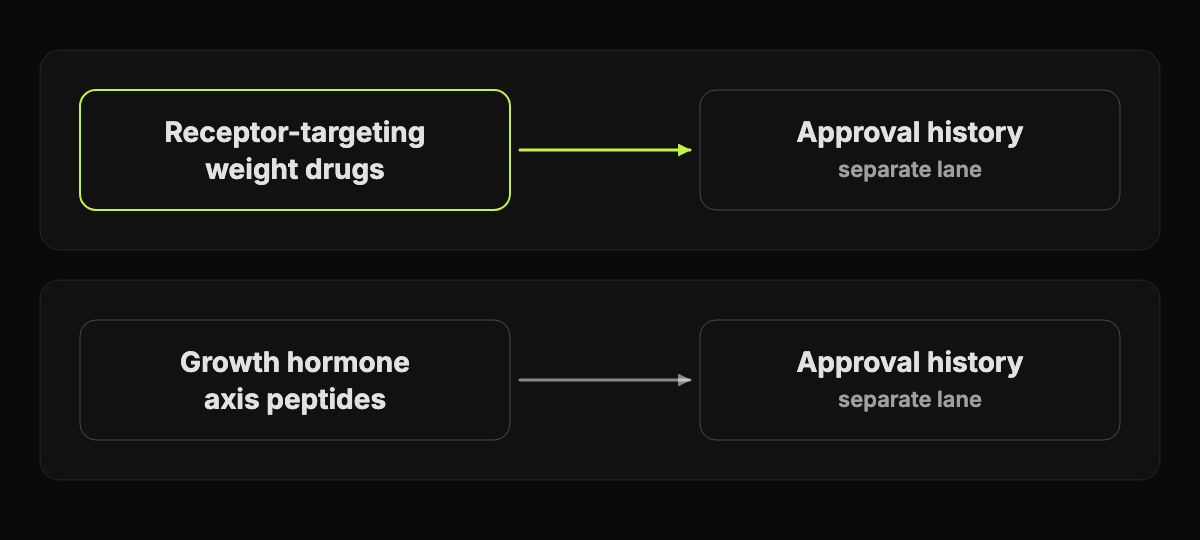
When searchers type "peptides," they often mean a second family: peptides that act on the growth hormone axis. These include sermorelin, tesamorelin, ipamorelin and CJC-1295. They do not act on the GLP-1 receptor, and they are not appetite drugs in the way GLP-1 drugs are described.
Here is what we could verify about each, using FDA documents and a drug label.
Sermorelin. Geref (sermorelin acetate) was FDA-approved in two forms. The small 0.05 mg ampule, approved 1990-12-28, was a test of how well the pituitary can release growth hormone. The vials, approved 1997-09-26, were for growth failure in children with idiopathic growth hormone deficiency. The manufacturer notified FDA of discontinuation in 2008, and withdrawal of approval took effect 2009-06-18. An FDA notice of 2013 said the Geref products were not withdrawn for reasons of safety or effectiveness, which is a regulatory finding and not an endorsement. An FDA advisory committee briefing dated 2024-12-04 states that no growth hormone secretagogue is approved for adult growth hormone deficiency.
What do studies show for body composition? A 2020 review by Sinha and colleagues calls the data sparse, with small, short studies. It describes one 16-week study with increased lean mass but no change in body weight or fat mass, and a 6-week study with no significant changes. We found no large trial showing meaningful weight loss or muscle gain from sermorelin in healthy adults.
Tesamorelin. The Egrifta label says it is indicated for the reduction of excess abdominal fat in HIV-infected adult patients with lipodystrophy. The same label lists, among limitations, that it is not indicated for weight loss management. The label describes it as 44 amino acids long.
Ipamorelin and CJC-1295. FDA briefing documents state that neither is an FDA-approved drug. FDA's page on bulk substances raises safety concerns about both, including immunogenicity and serious adverse events for ipamorelin and elevated heart rate and a vasodilatory reaction for CJC-1295. FDA warning letters have also named tesamorelin among products sold under "research use only" labels.
The takeaway: two peptides, two histories. GLP-1 drugs have large randomized trials for weight management behind brand-name labels. The growth hormone peptides are a patchwork: one old approval for children, one narrow label for a specific condition, and others never approved. For muscle-related questions, read our muscle growth guide.
Why the word confuses searchers
Three things stack up.
Marketing borrows the credibility. A seller of an unapproved compound can point out, accurately, that the approved GLP-1 drugs are peptides too. The implied jump from "also a peptide" to "also effective" is not supported. FDA's page on unapproved GLP-1 drugs states that unapproved versions are not reviewed for safety, effectiveness or quality.
Brand names scatter. Ozempic, Wegovy and Rybelsus are all semaglutide, and Mounjaro and Zepbound are both tirzepatide. A reader who sees six names can reasonably think there are six drugs. Our tirzepatide profile and semaglutide profile clear up which is which.
Compounded versions blur the line. Telehealth services, including Whoosh, list compounded semaglutide and compounded tirzepatide. Compounded drugs are not FDA-approved, and FDA says it does not review them for safety, effectiveness or quality before marketing. The word "peptide" attached to such a product does not make it equivalent to the brand, and the brand trial results do not describe it.
How the mechanisms differ, in plain language
The Ozempic label says semaglutide stimulates glucose-dependent insulin secretion and lowers glucagon, which are actions tied to the GLP-1 receptor. Tirzepatide adds the GIP receptor to that. Retatrutide, per the TRIUMPH-2 abstract, adds a glucagon receptor on top. Each step adds a target, and each was tested in its own trials with its own adverse event profile.
Growth hormone peptides work upstream. They signal the pituitary gland, and any effect on body composition would arrive indirectly through growth hormone. That is a separate biological pathway with a separate set of questions, including how the body responds in people who are not growth hormone deficient. FDA's advisory committee briefing notes that growth hormone improves body composition in adults with diagnosed deficiency, which is not the same population as healthy adults looking for a leaner physique.
So even if two products are both peptides, a claim made for one cannot be moved to the other. When you see a page quoting STEP 1 or SURMOUNT-1 figures next to a growth hormone peptide, the numbers belong to someone else's drug.
A vocabulary table
Use this as a decoder when a page throws terms around. The status column reflects the sources cited on this page.
| Term | What it means | Example | Status as we verified it |
|---|---|---|---|
| Peptide | A short chain of amino acids; a size description | Insulin, GLP-1, semaglutide | Not a regulatory status |
| GLP-1 receptor agonist | A drug that activates the GLP-1 receptor | Semaglutide | Wegovy approved for weight management; Ozempic and Rybelsus labeled for type 2 diabetes |
| Dual GIP/GLP-1 agonist | Activates both GIP and GLP-1 receptors | Tirzepatide | Zepbound approved for weight reduction; Mounjaro labeled for type 2 diabetes |
| Triple agonist | Acts on GIP, GLP-1 and glucagon receptors | Retatrutide | Not FDA-approved; Lilly plans an application in Q1 2027 |
| Growth hormone releasing peptide | Acts on the growth hormone axis, not GLP-1 | Sermorelin, tesamorelin | Sermorelin: approval withdrawn 2009-06-18; tesamorelin: narrow label for HIV lipodystrophy |
| Compounded drug | Made by a pharmacy or outsourcing facility to a prescription | Compounded semaglutide | Not FDA-approved; not reviewed for safety, effectiveness or quality |
| "Research use only" | A seller's label, not an approval | Peptide vials sold online | Unapproved new drugs where marketed for human use, per FDA warning letters |
What this means for choosing a path
If your question is whether GLP-1 drugs belong in the "peptides" conversation, they do, and they are the best-studied members of it. If your question is whether other peptides do the same job, the evidence we verified says that is unproven, absent or, for retatrutide, still in the approval process.
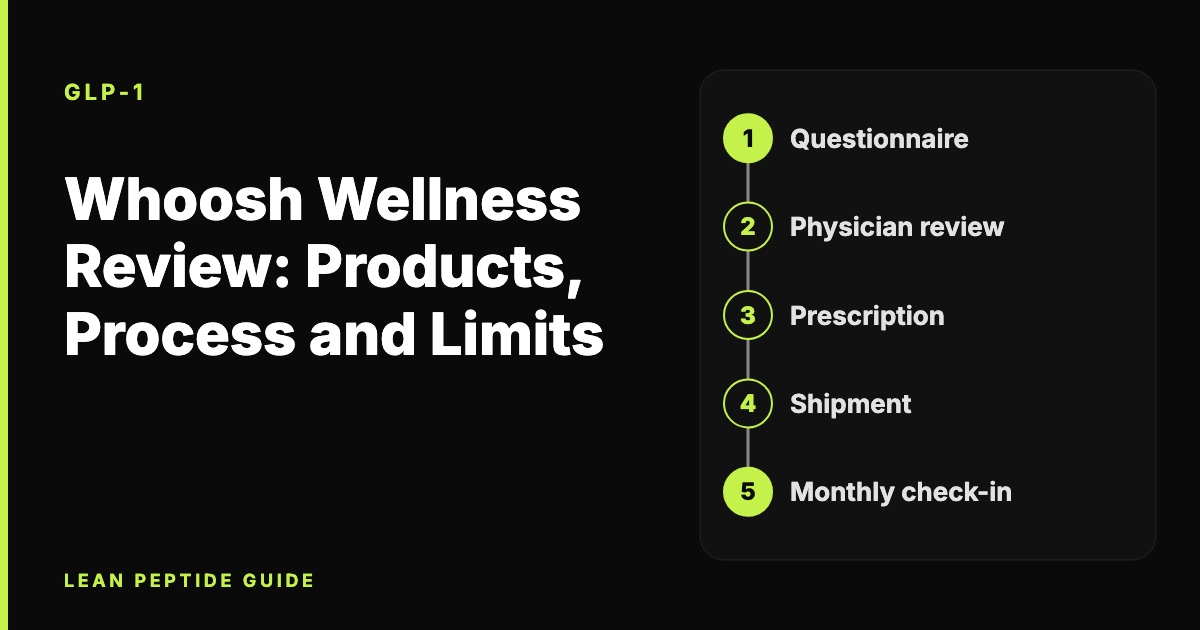
For people who want to ask a clinician about the approved drugs, there are several routes. Whoosh Wellness is one telehealth option; as stated by Whoosh, a licensed doctor reviews a short intake and prescribes "if appropriate." Whoosh says completing the intake does not guarantee a prescription, and it states that its compounded products are not FDA-approved finished drugs. Whoosh sells compounded tirzepatide, compounded semaglutide, sermorelin, NAD+, glutathione and a topical GHK-Cu product. It does not sell retatrutide, tesamorelin, ipamorelin or CJC-1295.
Some links here are affiliate links, so we may be paid if you sign up, and our descriptions of the drugs come from the labels rather than from that arrangement.
Remember that a licensed physician decides whether a prescription is appropriate, and no outcome is promised in advance.
Sources
- DailyMed: Ozempic label read 2026-10-06
- DailyMed: Rybelsus label read 2026-10-06
- Lilly: Mounjaro prescribing information read 2026-10-06
- Lilly: Zepbound prescribing information read 2026-10-06
- FDA: Zepbound label PDF read 2026-10-06
- DailyMed: Wegovy injection label read 2026-10-06
- DailyMed: Egrifta SV label read 2026-10-06
- Federal Register notice on Geref, via govinfo read 2026-10-06
- FDA advisory committee briefing, CJC-1295 and growth hormone secretagogues read 2026-10-06
- FDA advisory committee briefing, ipamorelin read 2026-10-06
- PubMed Central: Sinha et al., growth hormone secretagogues review read 2026-10-06
- FDA: bulk drug substances that may present significant safety risks read 2026-10-06
- FDA warning letter: Peak Performance Peptides read 2026-10-06
- FDA: concerns with unapproved GLP-1 drugs used for weight loss read 2026-10-06
- Lilly Q2 2026 earnings release (SEC) read 2026-10-06
- Europe PMC record: TRIUMPH-2 read 2026-10-06
- Whoosh Wellness: peptide therapy page, as stated by Whoosh read 2026-10-06
- Whoosh Wellness: FAQs read 2026-10-06
- Whoosh Wellness: terms and conditions read 2026-10-06
FAQ
Are GLP-1 drugs peptides?
Yes. Both are chains of amino acids with modifications; the Wegovy and Zepbound labels give molecular weights of 4113.58 and 4813.53.
Is tirzepatide a GLP-1 drug?
It activates the GLP-1 receptor and the GIP receptor, per its Mounjaro label. Many sources group it with GLP-1 drugs, though "dual agonist" is the more exact term.
Is sermorelin a GLP-1 peptide?
No. Sermorelin acts on the growth hormone axis. Its only FDA approval, under the Geref brand, was for pediatric growth issues and was withdrawn effective 2009-06-18. See our sermorelin vs ipamorelin comparison for the related compounds.
Are all peptides FDA-approved?
No. The word covers approved drugs and unapproved compounds alike. Ipamorelin and CJC-1295, for example, are described in FDA briefing documents as not FDA-approved drugs.
Do peptide supplements act like GLP-1 drugs?
We found no FDA statement saying they do, and we did not find evidence showing that. Our page on buying without a prescription covers what FDA says about unapproved products.
Can a compounded GLP-1 be called a peptide?
Chemically, the same ingredient name may apply. Regulatory status differs: compounded drugs are not FDA-approved and are not reviewed by FDA for safety, effectiveness or quality before marketing.
Is retatrutide a GLP-1 drug?
It acts on GLP-1 along with GIP and glucagon receptors, per the TRIUMPH-2 abstract in The Lancet. It is not FDA-approved.
Not medical advice. See the medical disclaimer.