Quick answer: Sermorelin and ipamorelin both prompt the pituitary to release growth hormone, but through different receptors. Sermorelin mimics the brain's GHRH signal and was once an FDA-approved brand drug for children. Ipamorelin activates the ghrelin receptor and has never been an approved drug; FDA has raised safety concerns about it. Whoosh offers sermorelin, not ipamorelin. Neither has strong human evidence for weight loss or muscle gain in healthy adults.
Searchers often put these two names side by side because both appear in the same marketing lists. The comparison is useful, but the two are not interchangeable and they do not share a regulatory history. This page walks through how each one works, where each stands with the FDA, what has been tested in people, and who offers them. For the single-compound story, see the sermorelin article; for the wider muscle question, see the muscle growth guide.
Plain-text note on partners: Whoosh Wellness offers sermorelin, not ipamorelin, so this page carries no Whoosh button and no affiliate link.
Two doors into the same room
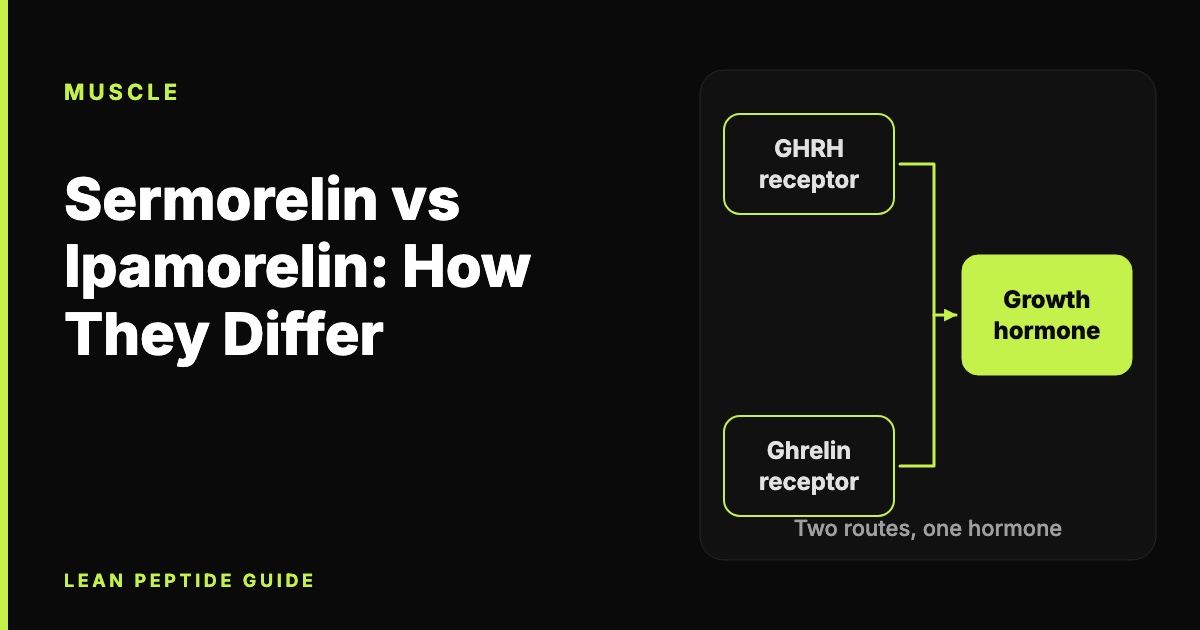
Growth hormone release from the pituitary can be prompted from more than one direction. Think of the pituitary cell as a room with two doors.
The first door is the GHRH receptor. The natural signal is growth-hormone-releasing hormone from the hypothalamus. Sermorelin is an analog of that hormone, so it knocks on this door. The related peptides CJC-1295 and tesamorelin also use it.
The second door is the ghrelin receptor, sometimes called the growth hormone secretagogue receptor. Ghrelin is a hormone best known for its role in hunger signaling. Ipamorelin activates that receptor on the pituitary cells that make growth hormone, according to FDA's advisory committee briefing on the compound.
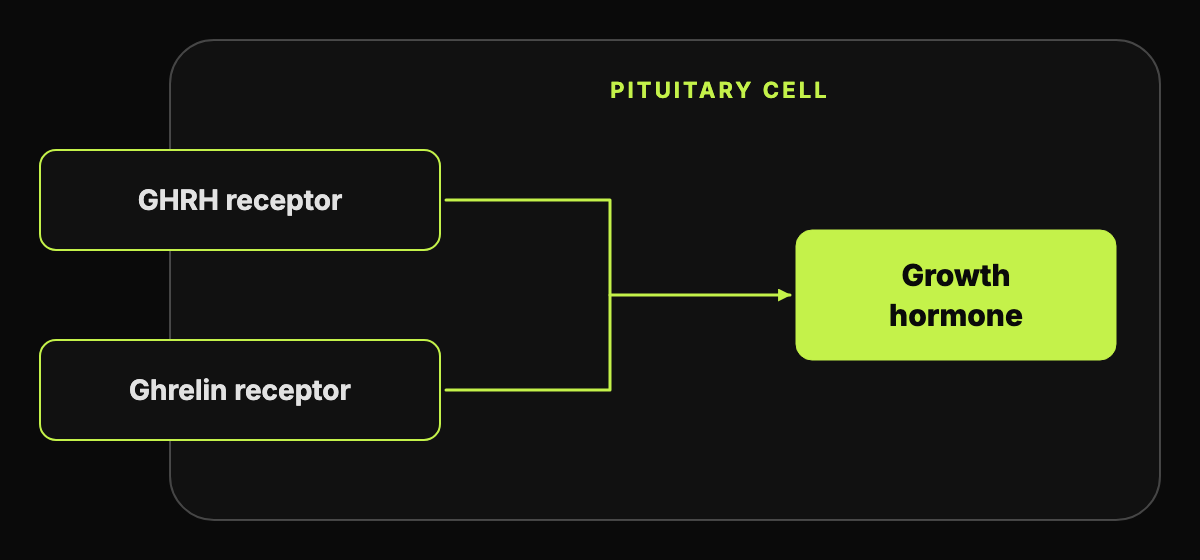
Why it matters: the two doors are different biology. A result seen with one cannot be carried across to the other. Reviews of this field sometimes group compounds together, and the grouping is how errors spread. For instance, a two-year body-composition study that appears in one review belongs to a compound called ibutamoren, which is a separate drug from ipamorelin. We do not attribute it to ipamorelin.
Regulatory status
Sermorelin
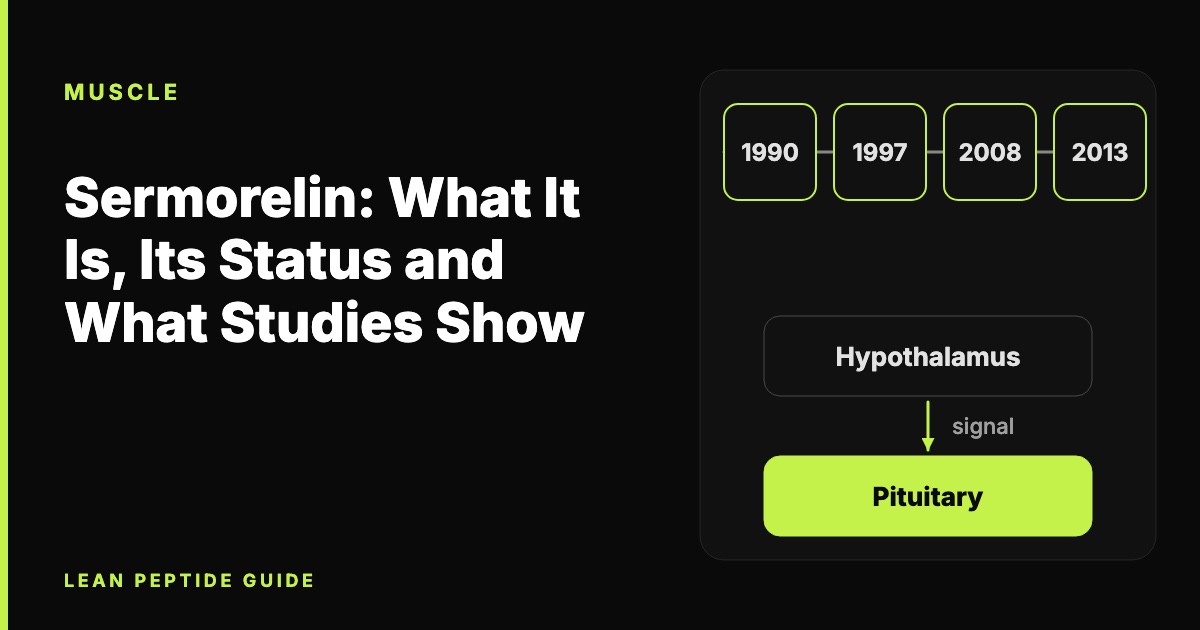
Sermorelin has a documented approval history. The brand Geref was approved by FDA in 1990 as a diagnostic ampule and in 1997 as vials for children with growth failure from idiopathic growth hormone deficiency. The maker stopped supplying it in 2008, and FDA's 2013 Federal Register notice said the products were not withdrawn for reasons of safety or effectiveness. Today it is not an approved product. It does not appear in Category 1, 2 or 3 of the FDA's 503A bulks list, version updated 2026-05-14, and the reason is not established in anything we opened.
Ipamorelin
Ipamorelin has never been an approved drug. FDA's advisory committee briefing on it, dated 2024-10-29, says so, and it also says FDA found no other human efficacy evidence it could use. Neither ipamorelin nor CJC-1295 appears in Category 1, 2 or 3 on the 503A document updated 2026-05-14.
Here is a conflict we want to flag openly. A separate FDA page on peptides with significant safety risks, updated 2026-04-22, appeared to us to describe ipamorelin as sitting in Category 2 for 503B outsourcing facilities only, with an addition date of 2023-09-29. The 503A list does not show it. The two pages may simply cover different pharmacy types, but we could not settle it, and a wrong category claim would mislead you. So we say only what is safe to say: FDA has raised safety concerns about ipamorelin.
Those concerns, as the FDA page states them, are a risk of immunogenicity (an immune reaction to the compound) and serious adverse events, including death with intravenous use, along with insufficient information about other routes of injection.
What "503A" and "503B" mean here
Compounding pharmacies fall into two broad groups under federal law. A 503A pharmacy prepares a medicine for an individual patient on a prescription. A 503B outsourcing facility prepares larger batches under stricter manufacturing standards. FDA keeps lists of bulk ingredients it will tolerate or has concerns about for each. Appearing on a list is not approval, and a compounded product is not FDA-approved in either case. Our compounded GLP-1s article explains the two pathways in more detail.
What has been tested in people
Sermorelin
The data are small and short. A 2020 review by Sinha and colleagues, whose summary of the field uses the word "paucity," cites a 16-week study that found more lean mass without a change in body weight or fat mass, and a 6-week study that found nothing significant across weight, BMI, waist-hip ratio, lean mass and percent fat. For children, a pediatric review reported flushing and injection-site pain as the most common effects.
Ipamorelin
FDA's document describes two human studies. One was a pharmacokinetic and dose-escalation study in 48 healthy male volunteers, published in 1999, which says how the compound moves through the body and does not measure whether it works for anyone with growth hormone deficiency. The other was a trial using intravenous ipamorelin after bowel resection to see whether it would help the gut recover. In that trial two participants given ipamorelin died of complications, with the relationship unclear, and low potassium and high blood sugar showed up more often. FDA found no other human efficacy evidence it could use.
The common ground
Neither compound has a published trial, among the sources FDA cited, that shows weight loss or muscle gain in healthy adults. That sentence is the main finding of this page. The compounds differ in mechanism and in regulatory history, but they are alike in how little has been demonstrated.
Sport
USADA states that sermorelin is prohibited in sport. For ipamorelin, we did not confirm the World Anti-Doping Agency wording from a primary page, because the WADA page we tried returned nothing. If you compete under anti-doping rules, check the current prohibited list yourself and assume that peptides of this kind may be banned until you have confirmed otherwise.
Who offers what
| Question | Sermorelin | Ipamorelin |
|---|---|---|
| How it works | Analog of GHRH; acts on the GHRH receptor | Activates the ghrelin receptor on pituitary cells |
| Ever an FDA-approved drug? | Yes, as Geref (1990 and 1997); discontinued 2008 | No |
| FDA-approved today? | No | No |
| FDA stance in sources we read | 2013 notice: products not withdrawn for safety or effectiveness | FDA has raised safety concerns |
| Human data cited | Small, short studies in adults; pediatric review | 48-man pharmacokinetic study; intravenous bowel-surgery trial |
| Weight loss or muscle gain shown in healthy adults? | No large trial found | No trial cited by FDA |
| Listed by Whoosh Wellness? | Yes, as injection or tablets | No |
| Sport | USADA: prohibited | Not confirmed from a primary page |
Whoosh Wellness lists compounded sermorelin among its six products, alongside tirzepatide, semaglutide, NAD+, glutathione and topical GHK-Cu. It does not list ipamorelin. Whoosh's compounded products are not FDA-approved, and a licensed physician decides whether a prescription is appropriate. If you see ipamorelin sold elsewhere, ask what the seller states about its source and whether it is labeled "research use only," a wording the FDA addressed in warning letters. Our guide on peptides without a prescription covers what that label means.
How we would decide between them
We are not telling you what to take, and you should not read this section as medical guidance. If we were choosing how to think about the choice, the questions would be these.
- Is it approved for a use I care about? For neither compound is the answer yes in adults.
- Who made it and who checked it? A compounding pharmacy that dispenses on a prescription differs from a seller of "research" vials.
- What does the sponsor claim, and what does a trial show? The two are rarely the same.
- Does the evidence match the goal? If the goal is weight or muscle, the strongest evidence points to approved weight-management drugs for weight, and training plus protein for muscle, not to either peptide.
Three mix-ups that travel with these names
"They are basically the same compound." They are not. They share a downstream effect, a rise in growth hormone, and almost nothing else: different receptors, different histories, different documents behind them.
"A list appearance means it is approved." A bulks-list category describes how FDA approaches a bulk ingredient for compounding. It is not a finding that the product works, and it is not an approval. A withdrawn nomination is not an approval either.
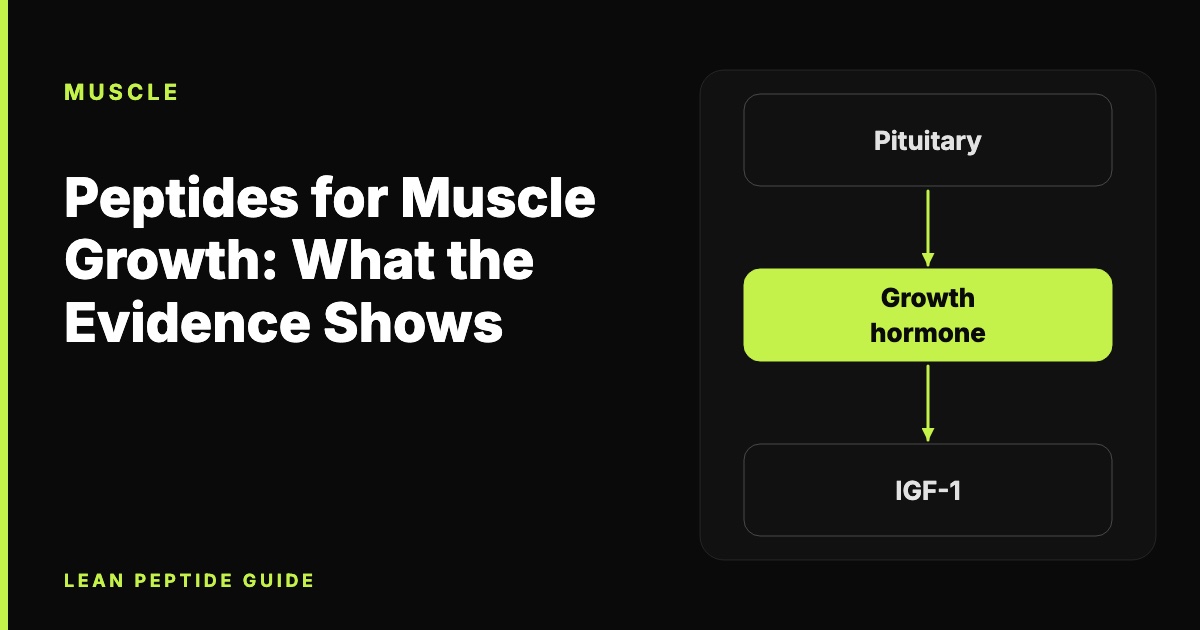
"More growth hormone means more muscle." In adults with a diagnosed deficiency, growth hormone therapy changes body composition. For people with a normal pituitary, the studies we found measured hormones, not results you could feel or lift. That gap is the reason we link our muscle growth guide rather than repeating its evidence table here.
Sources
- FDA advisory committee briefing, ipamorelin, 2024-10-29 read 2026-10-06
- FDA advisory committee briefing, CJC-1295 and GH secretagogues, 2024-12-04 read 2026-10-06
- FDA: bulk drug substances that may present significant safety risks read 2026-10-06
- FDA: 503A bulks list categories, updated 2026-05-14 read 2026-10-06
- Federal Register notice on Geref, 2013-03-04 read 2026-10-06
- Sinha et al. 2020, review of growth hormone secretagogues read 2026-10-06
- BioDrugs review of Geref in children (PubMed 18031173) read 2026-10-06
- USADA: Athletes, know sermorelin read 2026-10-06
- Whoosh Wellness: peptide therapy page read 2026-10-06
- FDA warning letter to Peak Performance Peptides, 2026-08-24 read 2026-10-06
FAQ
What is the main difference between sermorelin and ipamorelin?
They use different receptors. Sermorelin mimics the brain's GHRH signal, while ipamorelin activates the ghrelin receptor on pituitary cells. Both can prompt growth hormone release.
Is either one FDA-approved?
No. Sermorelin was once approved as the brand Geref and later discontinued. Ipamorelin has never been an approved drug, and FDA has raised safety concerns about it.
Which one has more human data?
Both have little. Sermorelin has small adult studies and a pediatric review. Ipamorelin's data, per FDA, come from a 48-man pharmacokinetic study and an intravenous trial after bowel surgery.
Does either help with weight loss or muscle?
We found no trial, among those FDA and the reviews cite, showing weight loss or muscle gain in healthy adults for either one.
Does Whoosh sell ipamorelin?
No. Whoosh lists sermorelin, offered as an injection or tablets. It does not list ipamorelin. Compounded products from any seller are not FDA-approved.
Is ipamorelin on an FDA bulks list?
Two FDA pages we read appear to differ, so we do not make a category claim. We say only that FDA has raised safety concerns about ipamorelin.
Are these peptides allowed in sport?
USADA says sermorelin is prohibited. For ipamorelin we did not confirm the current anti-doping wording from a primary page, so check the list directly if you compete.
Not medical advice. See the medical disclaimer.