Quick answer: Sermorelin is a laboratory version of a hormone-releasing signal from the brain. The brand product Geref was FDA-approved in the 1990s for diagnostic use and for children with growth failure, then discontinued by its maker in 2008. Sermorelin sold today is compounded and not FDA-approved. Studies of its effect on weight and body composition in adults are small and short, and no large trial shows meaningful weight loss or muscle gain.
People search for this peptide because it is marketed for weight, recovery and "lean body composition." This page separates what is documented from what is claimed. It does not repeat the broader muscle discussion, which lives in the muscle growth peptides guide, and it does not compare sermorelin with other peptides, which we do in the pages on ipamorelin and tesamorelin. Here the question is narrower: what can anyone responsibly say about sermorelin itself?
Disclosure: Whoosh Wellness lists sermorelin, and this page contains an affiliate button that can pay us a commission. A licensed physician decides whether a prescription is appropriate, and compounded medications are not FDA-approved.
What sermorelin is
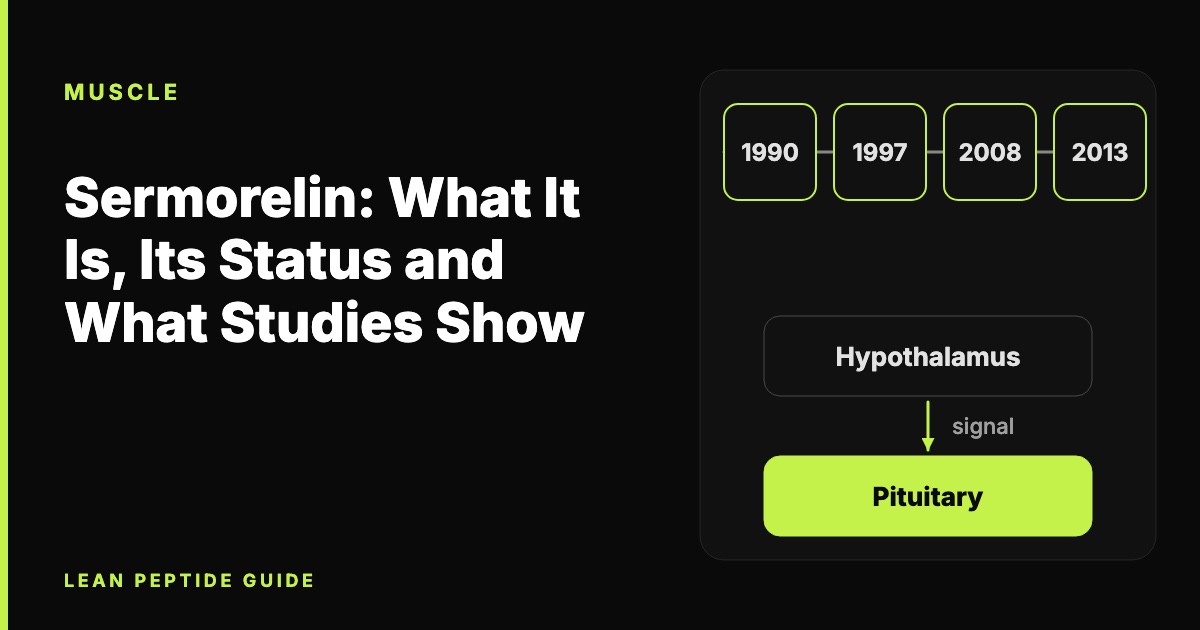
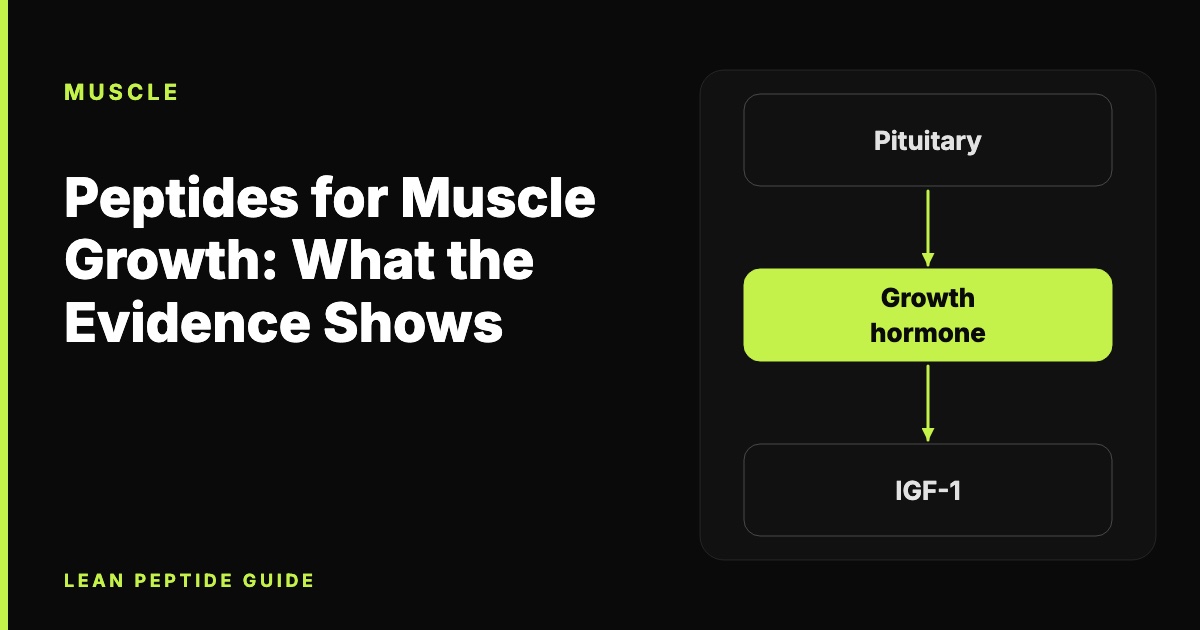
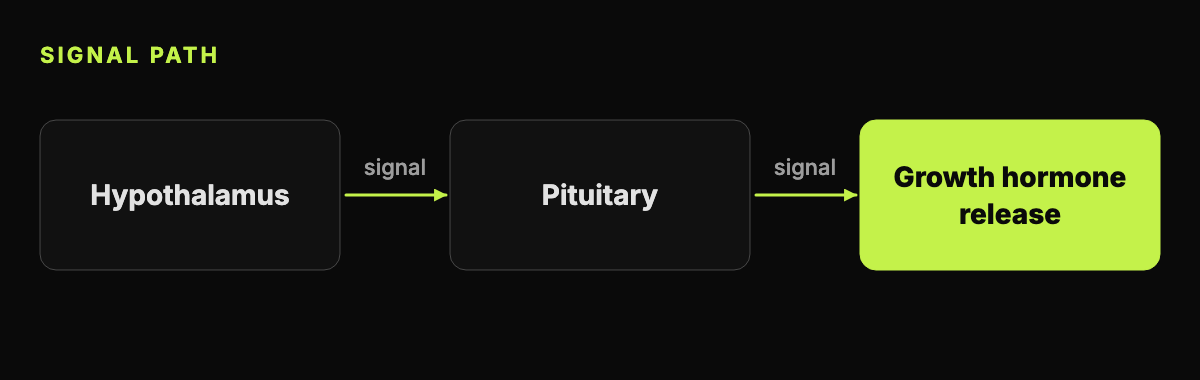
Sermorelin is an analog of GHRH, the growth-hormone-releasing hormone made in the hypothalamus. It acts on the GHRH receptor in the pituitary gland and prompts release of growth hormone. That separates it from peptides such as ipamorelin, which work through the ghrelin receptor.
Sources commonly describe it as the first 29 amino acids of GHRH. We could not confirm that number against a page we were able to open, so we regard the count as not confirmed. What we can say is that FDA's advisory committee briefing refers to the GHRH 1-29 fragment as the parent of a related peptide, CJC-1295.
The FDA history, step by step
The record here is unusually clean because it sits in a government notice.
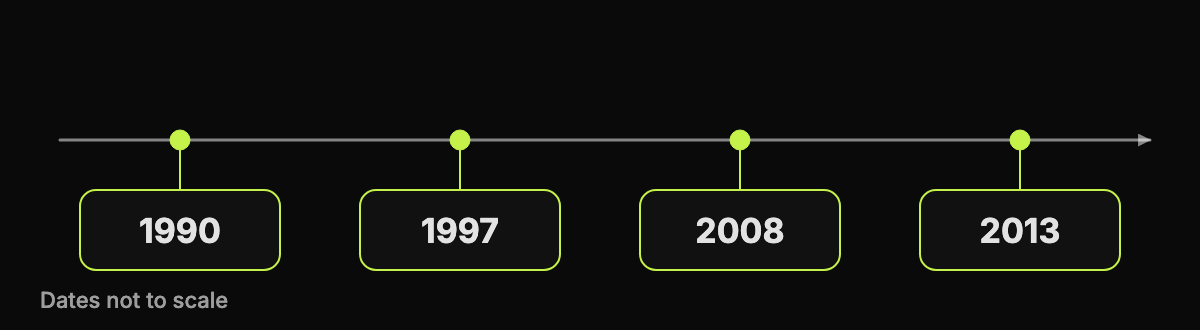
- 1990-12-28: FDA approved Geref (sermorelin acetate) in a 0.05 mg ampule, for evaluating how well the pituitary can secrete growth hormone. That is a diagnostic use.
- 1997-09-26: FDA approved 0.5 mg and 1.0 mg vials for idiopathic growth hormone deficiency in children with growth failure.
- 2008: The manufacturer told FDA it was discontinuing the products, on 2008-07-11 for the ampule and 2008-12-02 for the vials. The approvals were withdrawn effective 2009-06-18.
- 2013: In a Federal Register notice published 2013-03-04, FDA determined the Geref products "were not withdrawn for reasons of safety or effectiveness."
That last point is easy to misread in both directions. It does not mean sermorelin was pulled because of harm. It also does not mean FDA endorses it. The determination exists so other companies can reference the old approvals in applications. It says nothing about weight or muscle in healthy adults.
In its 2024-12-04 advisory briefing, FDA noted that among growth hormone secretagogues, only sermorelin was ever approved, for short stature caused by growth hormone deficiency in children whose Geref stimulation test showed a response. No secretagogue is approved for adult growth hormone deficiency.
Where it stands now: compounded, not FDA-approved
With the brand gone, sermorelin available now comes from compounding pharmacies. Compounded drugs are not FDA-approved and the agency does not review them for safety, effectiveness or quality before they reach patients. We cover how compounding works in compounded GLP-1s explained; the principles are the same.
Two regulatory observations from documents we opened on 2026-10-06:
- Sermorelin does not appear in Category 1, 2 or 3 of the FDA's 503A bulk-substances list, in the version updated 2026-05-14. We did not establish why. One explanation, that it is regarded as a component of a previously approved drug, is a guess we do not state as fact.
- FDA did not name sermorelin on its page listing peptides that may present significant safety risks (page updated 2026-04-22). Absence from that page is not a safety finding in either direction.
Separately, an FDA warning letter dated 2026-08-24 to a peptide seller did not name sermorelin among the products it cited. We note that only because readers ask; it tells you nothing about any specific seller.
What studies show on weight and body composition
The most useful single source we found is a 2020 review of growth hormone secretagogues by Sinha and colleagues. It describes the clinical data as "a paucity," small and short, mostly in healthy or experimentally hypogonadal men. For sermorelin it points to two small studies:
- A study by Khorram in 1997, running 16 weeks, found more lean mass but no change in body weight or fat mass.
- A study by Vittone, also 1997, running 6 weeks, found no significant change in weight, BMI, waist-hip ratio, lean mass or percent fat.
We could not find the sample sizes on the page we read, so we do not give them. The plain summary: one short study saw a lean mass signal and no fat change, another saw nothing measurable. That is not the profile of a weight loss tool, and it is not strong enough to call a muscle tool either.
It is also worth being clear about what is missing. We found no large randomized trial showing meaningful weight loss or muscle gain from sermorelin in healthy adults. Reading a lack of such a trial as "it works but nobody studied it" is a leap. The fair reading is "unknown."
Side effects, as documented
The evidence on adverse effects comes from a BioDrugs review of Geref in children. Brief facial flushing and injection-site pain led the list of effects, and the authors called the drug well tolerated in that setting. In children the effect on growth rate was smaller than that of somatropin, the standard growth hormone drug.
Two cautions. First, we did not open the Geref label itself, so we cannot list its full adverse-reaction section. Second, a pediatric review does not describe the experience of an adult taking a compounded product of unknown source. If a clinician recommends a drug in this class, the side-effect conversation belongs with that clinician.
Sport
USADA states that sermorelin is prohibited in sport. If you are subject to anti-doping rules, that is the end of the question, and you should check the current list before using anything in this class.
What Whoosh says about its sermorelin
Whoosh Wellness lists sermorelin as one of six products, offered as an injection or as tablets, according to its product and pricing pages that we read on 2026-10-06. We do not publish any prices, because the pages we read showed more than one set of figures.
On its product page, Whoosh describes sermorelin with lines such as supporting the body's own growth hormone production, supporting post-training recovery and supporting lean body composition goals. Read those lines as the company's marketing description. They are not findings from a study, and the research above does not establish them. We make no efficacy claim for Whoosh's sermorelin.
What the process looks like, according to Whoosh: you complete an online intake, and a licensed physician decides whether a prescription is appropriate. Whoosh says billing happens only on physician approval and that finishing the intake does not mean a prescription will be written. If you want the company's own description in one place, our Whoosh Wellness review lays out what it says and what it leaves unstated.
Approval is never promised: a licensed physician decides whether a prescription is appropriate, and Whoosh's sermorelin is compounded and not FDA-approved.
What we can and can't say about sermorelin
| What we can say | What we can't say |
|---|---|
| Geref, the brand product, was FDA-approved in 1990 and 1997 for narrow uses. | That sermorelin is FDA-approved today. It is not. |
| The manufacturer discontinued Geref in 2008; FDA later said this was not for safety or effectiveness reasons. | That FDA has endorsed sermorelin for any current use. |
| Sermorelin acts on the GHRH receptor and prompts growth hormone release. | That raising growth hormone in a healthy adult produces a measurable change in weight or muscle. |
| Two small 1997 studies looked at body composition in adults; one found more lean mass without a change in fat mass, the other found no significant change. | That sermorelin causes weight loss, or builds muscle. No large trial supports that. |
| Flushing and injection-site pain were the most common effects in a pediatric review. | That it is "safe" in adults taking compounded products. The data do not cover that. |
| USADA says it is prohibited in sport. | That athletes may use it. |
| Whoosh offers sermorelin, and describes it in its own marketing language. | That Whoosh's description is a research finding. |
How to weigh a sermorelin claim
When you see a claim about sermorelin online, run three checks. Does it cite a trial with named participants, a length and a number, or only a mechanism? Does it say whether the product is approved or compounded? And does it come from someone who sells it? A claim that fails all three is advertising. Our guide to are peptides safe goes through source quality in more detail.
If your real goal is weight management, the weight loss peptides guide covers what is approved and what is only studied. If your goal is muscle, the basics of training and protein do more than any product we reviewed.
Questions worth bringing to a clinician
Because we do not give medical advice, we will only suggest the kind of questions a cautious reader might ask a prescriber who proposes sermorelin. Which pharmacy prepares it, and does that pharmacy state its source for the ingredient? What outcome is the goal, and how would you both know whether it was reached? What does the prescriber make of the thin research summarized above? Are there approved options for the same goal that have trial data behind them? And what should be reported right away if something feels wrong?
None of these questions is a trap. A good prescriber should be comfortable with them, and the answers will tell you more than any web page, including this one.
Sources
- Federal Register notice on Geref (sermorelin acetate), 2013-03-04 read 2026-10-06
- FDA advisory committee briefing document, 2024-12-04 read 2026-10-06
- FDA: 503A bulks list categories, updated 2026-05-14 read 2026-10-06
- FDA: bulk drug substances that may present significant safety risks read 2026-10-06
- FDA warning letter to Peak Performance Peptides, 2026-08-24 read 2026-10-06
- Sinha et al. 2020, review of growth hormone secretagogues read 2026-10-06
- BioDrugs review of Geref in children (PubMed 18031173) read 2026-10-06
- USADA: Athletes, know sermorelin read 2026-10-06
- Whoosh Wellness: peptide therapy page read 2026-10-06
FAQ
Is sermorelin FDA-approved?
Not today. The brand product Geref was approved in 1990 and 1997 and later discontinued by its manufacturer. Compounded sermorelin is not FDA-approved.
Was sermorelin taken off the market because it was unsafe?
Not for safety or effectiveness reasons, according to FDA's 2013 determination. That finding explains the brand's exit; it is not an endorsement of anything sold today.
Does sermorelin cause weight loss?
We found no large trial showing it does. In a small review-cited study, body weight and fat mass did not change after 16 weeks, and another study found no significant change in weight after 6 weeks.
Does sermorelin build muscle?
The evidence is thin. One small study saw more lean mass without a change in fat, and lean mass is not the same as muscle. No large trial shows muscle gain in healthy adults.
What are the known side effects?
A pediatric review found flushing and injection-site pain were the most common effects. We did not open the Geref label, so we cannot list its full adverse-reaction section.
Is sermorelin allowed in sports?
USADA says it is prohibited. Athletes subject to testing should check the current prohibited list before using any peptide.
How does Whoosh describe its sermorelin?
Whoosh says it supports the body's own growth hormone production and lean body composition goals, offered as an injection or tablets. Those are the company's descriptions, not findings, and a licensed physician decides whether a prescription is appropriate.
Not medical advice. See the medical disclaimer.