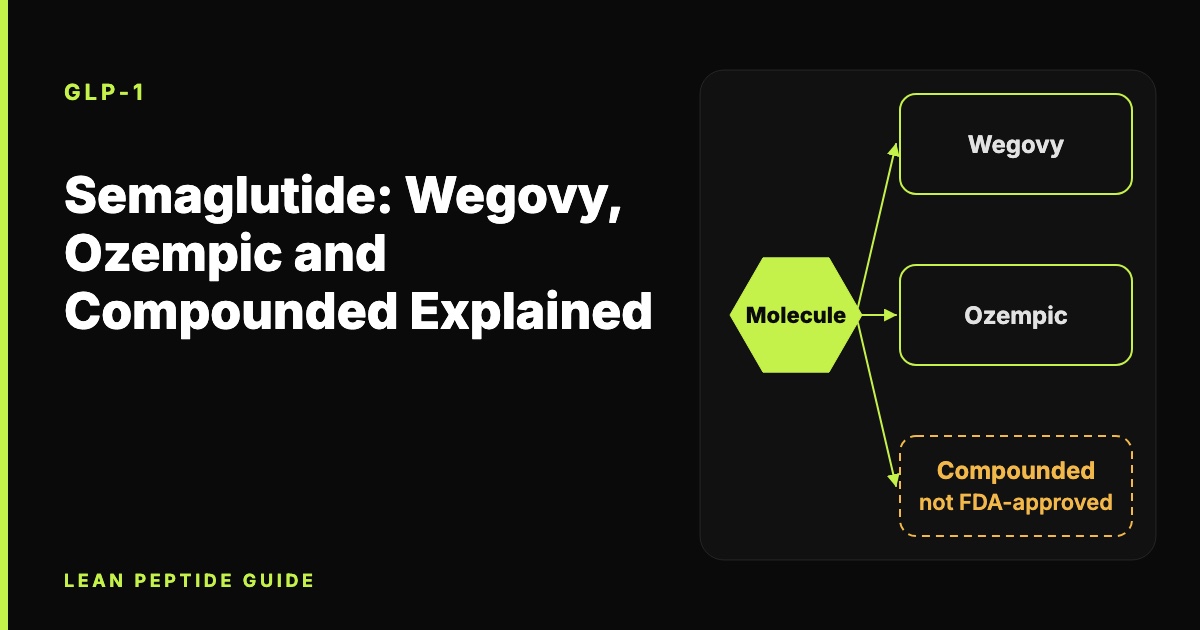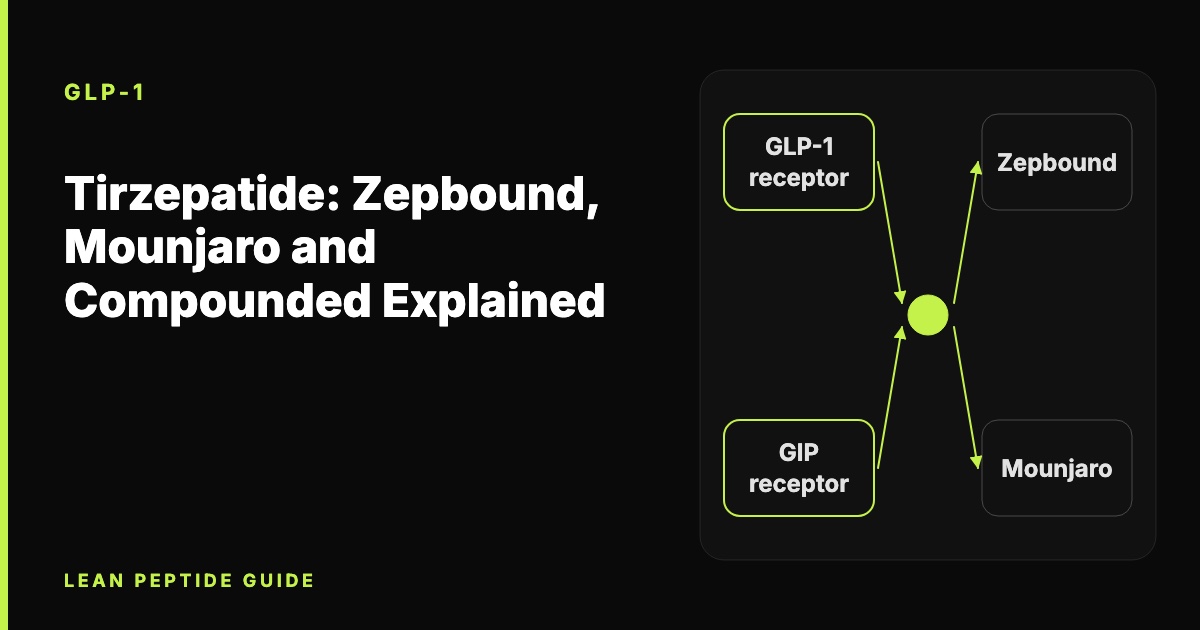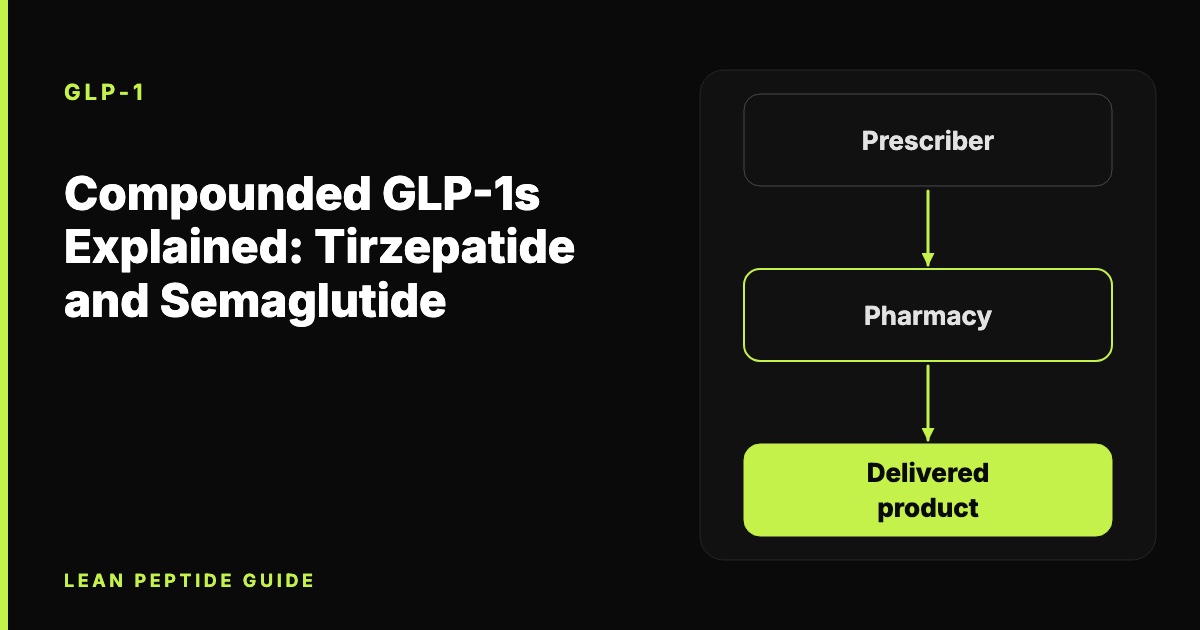
Quick answer: Compounded semaglutide and tirzepatide are custom-made versions of the active ingredients in Wegovy and Zepbound, prepared by a pharmacy. They are not FDA-approved, and FDA does not review them for safety, effectiveness or quality before they are marketed. FDA says the shortages of both drugs are resolved, which narrowed when compounding is allowed. A prescriber and a named pharmacy matter more than any label on a vial.
This guide explains what compounding is, who does it, what FDA has said and when, and what to ask before you accept a compounded prescription. Some links on this page are affiliate links, so we may earn a commission if you use them; our affiliate disclosure says more. The page describes risks and facts, not a reason to start anything.
What compounding is
Compounding is the practice of a pharmacist or outsourcing facility mixing, altering or preparing a medicine to fit a prescription. Done well, it fills real gaps: a liquid form for someone who cannot swallow a tablet, or an ingredient removed for an allergy. FDA's general compounding questions-and-answers page (dated 2025-09-16) is direct about the limit: compounded drugs are not FDA-approved, and the agency does not verify their safety, effectiveness or quality before they are marketed. It adds that poor compounding can cause contamination or a wrong strength.
An FDA-approved drug such as Wegovy or Zepbound has gone through review of its manufacturing, its labeling and trial evidence. A compounded product skips that review by design. That is the whole reason the approved brands and compounded versions cannot be regarded as interchangeable, a point we also make in tirzepatide vs semaglutide.
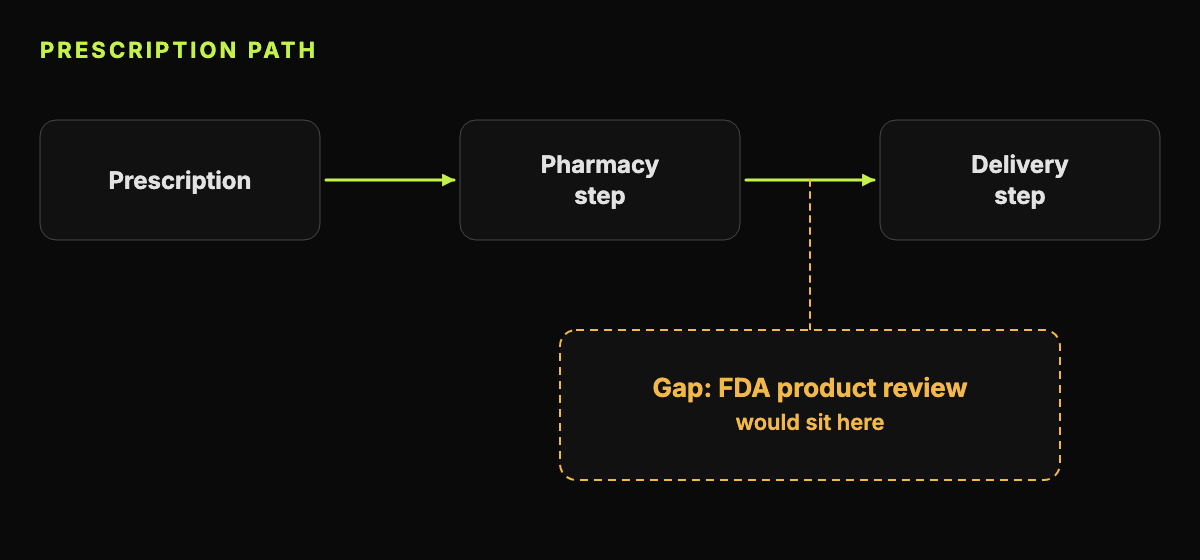
How the rules changed: shortages and enforcement dates
Compounding copies of an approved drug is far easier while that drug is on FDA's shortage list. Here is the sequence, as FDA records it.
- Tirzepatide. FDA first listed a shortage on 2022-12-15, removed it on 2024-10-02, then reevaluated and issued a new resolved determination dated 2024-12-19. The memo mentions a lawsuit filed 2024-10-07.
- Semaglutide. The shortage listings began in March 2022 (Wegovy) and August 2022 (Ozempic). FDA determined the shortage resolved in a decision memo dated 2025-02-21.
- Enforcement discretion. After each determination FDA gave compounders a window before it would act against large-scale copies. According to an FDA page dated 2026-04-01, those windows ended on 2025-02-18 for tirzepatide and 2025-04-22 for semaglutide at 503A pharmacies, and on 2025-03-19 for tirzepatide and 2025-05-22 for semaglutide at 503B outsourcing facilities. The page also notes a court decision dated 2025-04-28 connected to the semaglutide dates; we do not describe that ruling because we could not establish what it covered.
- A narrow carve-out. The same page says FDA does not intend to act against a compounder that fills four or fewer prescriptions per calendar month of a product that is "essentially a copy," under stated conditions. It is a conditional statement about enforcement, not an approval of the product.
Shortage language lingers in marketing long after FDA's lists changed. FDA's listings describe both shortages as resolved, so an ad implying the drug is still in shortage is out of date.
The 2026-04-30 proposal
On 2026-04-30 FDA announced a proposal to exclude semaglutide, tirzepatide and liraglutide from the 503B bulks list, finding no clinical need for outsourcing facilities to compound them from bulk substances. The comment deadline was 2026-06-29. As we read it, this is a proposal, not a final rule. Nothing on the announcement page we opened said the exclusion had taken effect, so anyone writing that 503B compounding of these drugs "is banned" is getting ahead of the record. Check FDA's page for the current status.
503A vs 503B
Two federal pathways produce most compounded GLP-1 products. They are often blurred together in ads. The table below uses only what FDA's comparison page (dated 2021-08-13) states.
| 503A pharmacy | 503B outsourcing facility | |
|---|---|---|
| Prescription requirement | Needs a valid prescription for an identified individual patient | May or may not have patient-specific prescriptions |
| Federal registration | Not described as an outsourcing facility | Must meet the registration and reporting requirements of section 503B(b) |
| Current good manufacturing practice (CGMP) | FDA's table says it is exempt | Not confirmed on the page we read; check FDA directly |
| New-drug approval | Exempt from section 505 | Exempt from section 505 |
| FDA product review before sale | None | None |
Read the CGMP row carefully. FDA's summary lists 503A compounding as exempt from CGMP. For 503B, the version of the page we opened did not state a CGMP point in a form we could confirm, and we did not find a source we could open that settles it, so we make no claim either way. Both pathways are exempt from new-drug approval, which is why neither produces an FDA-approved product.
Both pathways are legitimate in the legal sense. Neither one is a quality seal. A product's pathway tells you who made it and what legal route applies, not whether FDA examined that batch.
What FDA says about risks
FDA's page on unapproved GLP-1 drugs used for weight loss (last updated 2026-10-01) is the best single read. In summary:
- Compounded drugs are not FDA-approved and are not reviewed for safety, effectiveness or quality.
- FDA reports multiple adverse events from patients' self-dosing mistakes and providers' miscalculations, with some patients receiving doses above the approved label and some hospitalized. Multi-dose vials should be discarded 28 days after first use.
- Semaglutide salt forms (sodium, acetate) are not approved, and FDA says there is no evidence of equivalence for them.
- Counterfeit Ozempic has appeared in the US supply, and fraudulent pharmacies have used false credentials.
- Some products are labeled "for research purposes" or "not for human consumption" and still sold with human dosing instructions.
- Through 2026-05-31, FDA had received 990 adverse event reports for compounded semaglutide and over 730 for compounded tirzepatide. FDA does not say these reports prove a product caused an event; reports come from many sources and do not give a rate.
The 2024-07-26 dosing-error alert
FDA's alert to providers, compounders and patients, dated 2024-07-26, described patients drawing 5 to 20 times the intended amount from multi-dose vials. It cited confusion among mL, mg and "units," including an example of 50 units drawn on a syringe when 5 was intended, and conversion errors by providers. The events it listed included nausea, vomiting, abdominal pain, fainting, dehydration, pancreatitis and gallstones, with some people hospitalized. FDA's Compounding Risk Alerts page lists that alert as its only semaglutide entry. The takeaway is about process, not arithmetic: any prescriber should explain a product's strength in the units printed on its own label.
Counterfeits and "research use only"
Two warnings recur in FDA's material.
Counterfeits. FDA's page names counterfeit Ozempic in the US supply and fraudulent pharmacies with false credentials. Its listed red flags are prices that seem too good to be true, damaged packaging and no licensed physician oversight. We cover buying routes in more depth in weight loss peptides without a prescription.
"Research use only." FDA's warning letter of 2026-03-31 to a seller named Gram Peptides took the position that the disclaimer changes nothing: the products were marketed for use in people, so they counted as unapproved new drugs. The letter also noted injectables sold alongside diluent water. A vial with that wording is not a compounded prescription; it is an unapproved product with a disclaimer printed on it. Our look at the broader category is in are peptides safe.
What "third-party tested" and "FDA-registered facility" do and don't mean
Providers, Whoosh included, use both phrases. Whoosh's home page says its compounded medications come from "FDA-registered facilities but are not FDA-approved," and its sitewide copy says every batch is third-party tested. Here is how to read them.
- "FDA-registered facility." Registration means a facility told FDA it exists. It is not approval, inspection results or a quality endorsement, and it says nothing about the specific product. Whoosh's own text states the products are not FDA-approved.
- "Third-party tested." The phrase does not say what was tested (identity, strength, sterility, endotoxin), by which lab, to what standard, or whether the result was shared with you. Ask for the certificate for your batch, not a general statement.
- "Made in a 503A/503B pharmacy." This does not tell you which pathway made your product. Whoosh states that its medications may be compounded by licensed pharmacies under section 503A or 503B, and its product pages do not name a specific pharmacy per product. That is the reason for the questions below.
Eight questions to ask any provider
- Which pharmacy or outsourcing facility will fill my prescription, and is it licensed in my state?
- Is the product made under 503A or 503B?
- Can I see the label that will be on the vial, with strength written in mg and in the volume on the vial?
- Is the active ingredient the same form used in the approved drug, or a salt form such as sodium or acetate?
- What third-party testing exists for my batch, and can I see the report?
- Who adjusts the plan if I have side effects, and how do I reach that person?
- What is the discard date, and how should the product be stored and shipped?
- What happens if I want to stop, switch to an approved brand or report a problem?
If a provider cannot answer these in plain language, that is information in itself.
Whoosh states that intake is for people 18 or older in a state where its services are available, that availability varies by state law and pharmacy licensing, and that finishing the intake does not guarantee a prescription. A licensed physician decides whether a prescription is appropriate. These points are as stated by Whoosh.
What Whoosh states about its GLP-1 products
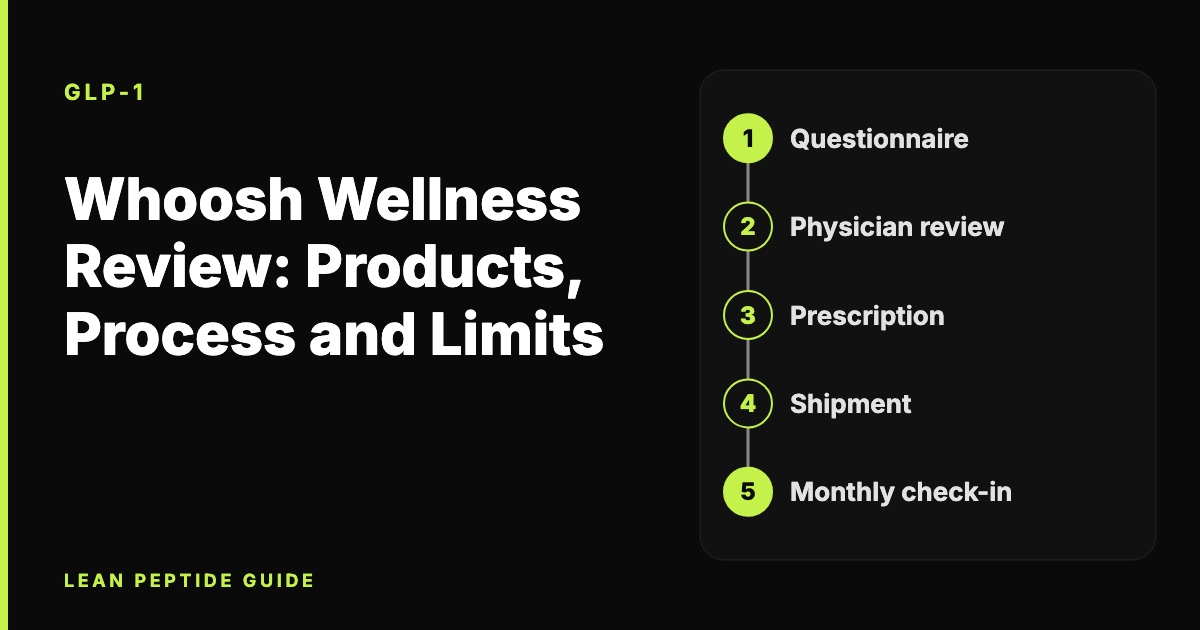
According to Whoosh's own pages, it is a telehealth platform offering physician-prescribed protocols. Its stated process is a short questionnaire, an individual review by a licensed doctor who prescribes "if appropriate," shipping to the door and monthly check-ins. It lists compounded tirzepatide and compounded semaglutide, both not FDA-approved, among its products, alongside sermorelin, NAD+, glutathione and topical GHK-Cu. It does not offer retatrutide; we explain why that matters in retatrutide FDA status.
We do not repeat Whoosh's marketing descriptions of what its products do, and we do not state any efficacy for them. The trial figures people quote online belong to Wegovy and Zepbound as tested in trials, not to compounded versions. For a closer look at the partner itself, see our Whoosh Wellness review.
Sources
- FDA: concerns with unapproved GLP-1 drugs used for weight loss read 2026-10-06
- FDA: alert on dosing errors with compounded semaglutide, 2024-07-26 read 2026-10-06
- FDA: compounding risk alerts read 2026-10-06
- FDA: compounding and the FDA, questions and answers read 2026-10-06
- FDA: tirzepatide shortage determination memo read 2026-10-06
- FDA: semaglutide shortage determination memo read 2026-10-06
- FDA: policies for compounders as GLP-1 supply stabilizes read 2026-10-06
- FDA: proposal to exclude semaglutide, tirzepatide and liraglutide from the 503B bulks list read 2026-10-06
- FDA: FD&C Act provisions that apply to human drug compounding read 2026-10-06
- FDA warning letter: Gram Peptides, 2026-03-31 read 2026-10-06
- Whoosh Wellness home page read 2026-10-06
- Whoosh Wellness terms and conditions read 2026-10-06
- Whoosh Wellness FAQs read 2026-10-06
FAQ
Do compounded GLP-1s have FDA approval?
No. Compounded semaglutide and tirzepatide are not FDA-approved, and FDA says it does not review them for safety, effectiveness or quality before they are marketed. Approved brands such as Wegovy and Zepbound are separate products with their own labels.
Is the shortage still going?
FDA's records list both shortages as resolved: tirzepatide with a determination dated 2024-12-19 and semaglutide with a decision memo dated 2025-02-21. Marketing that says otherwise may be out of date.
Did FDA ban 503B compounding of these drugs?
Not as far as we could confirm. On 2026-04-30 FDA proposed excluding semaglutide, tirzepatide and liraglutide from the 503B bulks list, with a comment deadline of 2026-06-29. That is a proposal, not a final rule, so check FDA's page for the current status.
What is the difference between 503A and 503B?
According to FDA's comparison table, a 503A pharmacy compounds against a prescription for an identified patient, while a 503B outsourcing facility may or may not have patient-specific prescriptions and must meet registration and reporting requirements. Neither pathway yields an FDA-approved drug.
Does "FDA-registered" mean FDA checked my product?
No. Registration means the facility is on record with FDA. It is not approval of any product, and Whoosh's own text says its products are not FDA-approved.
What should I do with a vial labeled "research use only"?
It is an unapproved product. FDA's 2026-03-31 warning letter to Gram Peptides said the wording does not alter the product's intended use in people. A prescriber is the right person to ask about approved options.
Can I trust the weight-loss numbers I see for compounded products?
Trial numbers belong to the approved brands in their trial populations. We found no trial that tested compounded versions, so figures attached to them online are not a finding about the compounded product.
Not medical advice. See the medical disclaimer.