Quick answer: No peptide is approved by the FDA to build muscle in healthy adults. The growth-hormone peptides people ask about are either approved for something narrow (tesamorelin), were approved once for children (sermorelin), or are not approved drugs at all (ipamorelin, CJC-1295). GLP-1 drugs are not muscle builders either. The best-supported inputs are resistance training and enough protein. Below is a status table and a plain look at the human data.
If you landed here from a search for "peptides for muscle growth", you probably want to know whether a shortcut exists. We looked at the primary sources: FDA briefing documents, drug labels, published trials and federal activity guidelines. The honest answer is less exciting than the marketing, and it is worth reading before you spend money or take a risk with an injectable.
This page is about muscle. If your goal is weight loss, the weight loss peptides guide covers that side, and the GLP-1 muscle loss article covers what happens to lean tissue on those drugs. We do not recommend any product here, and a button for Whoosh does not appear on this page because Whoosh does not sell a muscle-growth peptide.
What counts as a "muscle peptide"
A peptide is a short chain of amino acids. Many hormones are peptides, and several approved drugs are too. When people search for muscle-growth peptides they usually mean a small group that acts on the growth-hormone (GH) system: sermorelin, tesamorelin, ipamorelin and CJC-1295. Sellers often add BPC-157 and others, but those are not GH-axis peptides, and the FDA's position on them is a separate topic covered in are peptides safe.
Notice what the label "muscle peptide" implies: that the compound causes muscle to grow. In the sources we read, no regulator says that about any of these four. What exists is a chain of biology (a signal, a hormone, a second hormone) and a thin layer of studies that mostly measured hormone levels, not muscle.
The growth-hormone axis in plain words
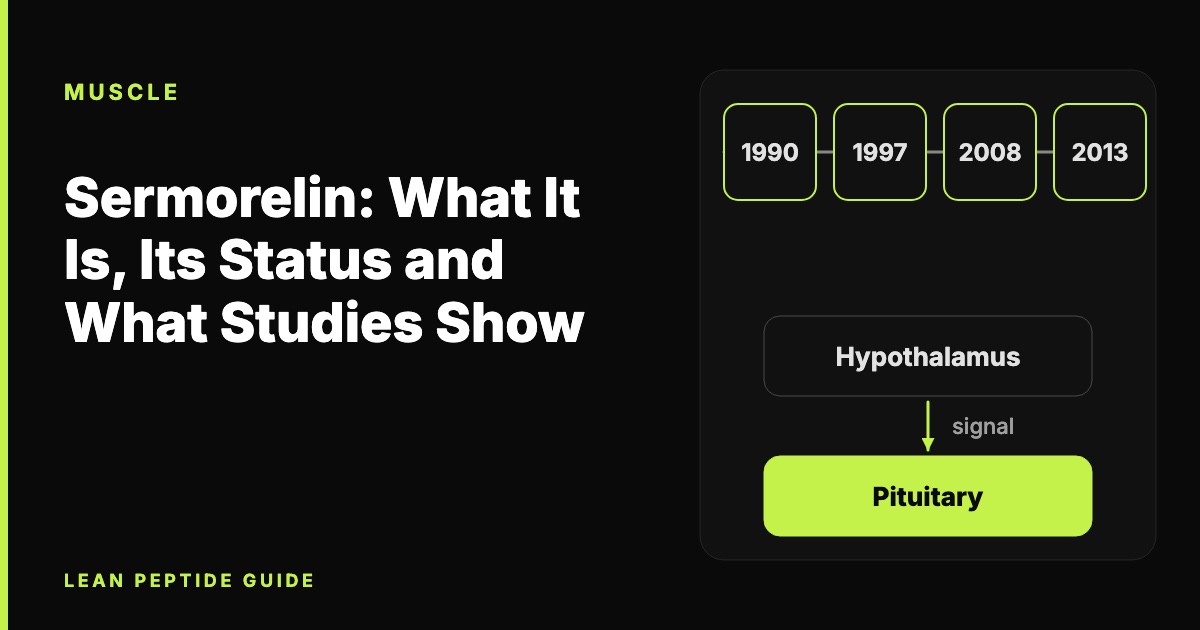
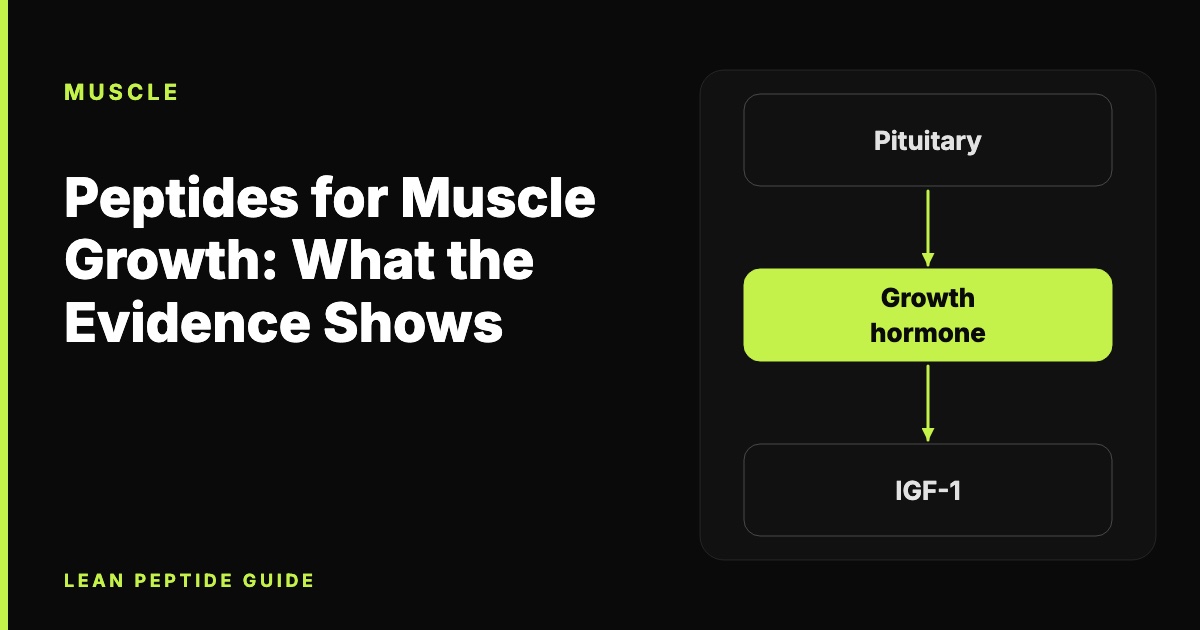
The pituitary gland, at the base of the brain, releases growth hormone in pulses. A hypothalamic signal called GHRH (growth-hormone-releasing hormone) tells the pituitary to release it. A different signal, working through the ghrelin receptor, can also prompt release. Growth hormone then acts on tissues and prompts the liver to produce IGF-1, which carries many of its effects.
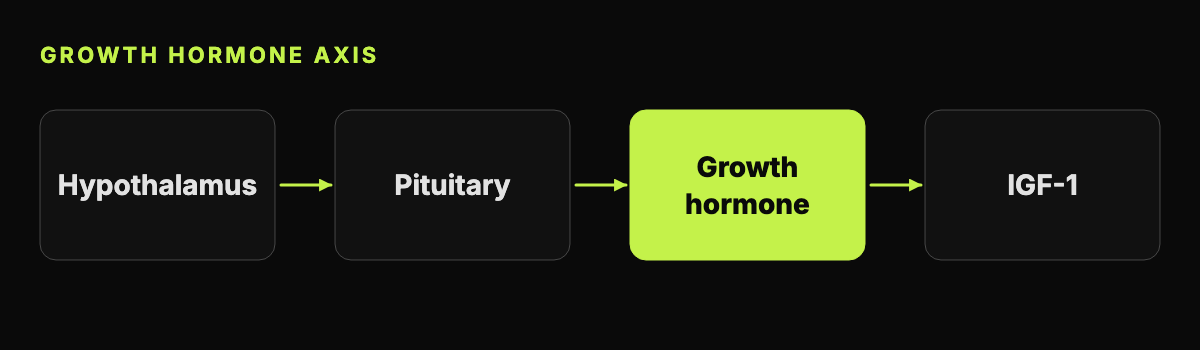
The four peptides in this article plug into that chain at two points. Sermorelin, tesamorelin and CJC-1295 are all related to GHRH, so they act through the GHRH receptor. Ipamorelin activates the ghrelin receptor on the pituitary cells that release GH, according to FDA briefing documents. Raising GH in the blood is a measurable event. Whether it produces more muscle in a healthy adult is a separate question, and that question is where the evidence thins out.
One clear point from the FDA's own advisory committee materials: in adults who are growth-hormone deficient, GH therapy improves body composition, including muscle mass. That finding concerns people with a diagnosed deficiency. It does not tell us what a GH-releasing peptide does in someone whose pituitary works normally.
What actually builds muscle
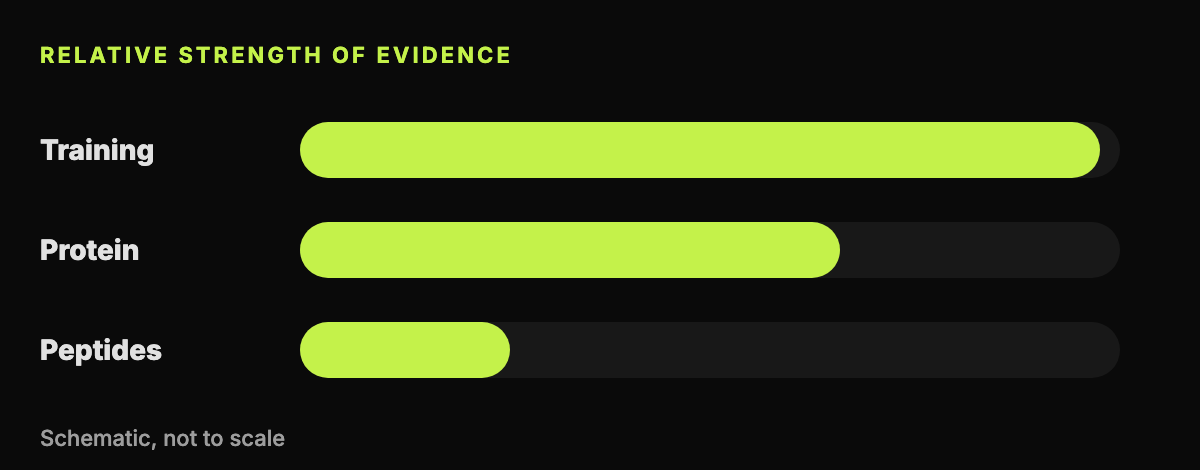
Before the peptides, the baseline. The CDC, drawing on the Physical Activity Guidelines for Americans, says adults need muscle-strengthening activity on 2 days a week that works all the major muscle groups, alongside 150 minutes a week of moderate aerobic activity (CDC page updated 2023-12-20). The federal ODPHP summary agrees: lifting weights, push-ups and similar work "at least 2 days each week" (page updated 2025-11-19). We could not confirm the publication year of the guideline edition from that page, so we do not state it.
On protein, the best-known synthesis is a 2018 meta-analysis by Morton and colleagues in the British Journal of Sports Medicine. It pooled 49 randomized trials with 1,863 participants who did resistance training for at least 6 weeks. In the abstract we read, protein supplementation added 0.30 kg of fat-free mass (95% CI 0.09 to 0.52) on top of training. The authors found no further gain once total protein intake passed 1.62 g/kg/day, the benefit shrank with age, and it was larger in people who were already trained.
Read that with its limits in view. These were healthy adults. The effect is modest, a fraction of a kilogram, not a dramatic change. And fat-free mass includes more than muscle. Even so, it is a measured, repeated, peer-reviewed result, which is more than any of the peptides below can offer for healthy adults.
GLP-1 drugs are not muscle builders
Because this site covers both topics, we want to be direct about GLP-1 medicines such as semaglutide and tirzepatide. They are approved for weight management and other uses on their labels, not for gaining muscle. In trial body-composition substudies, people lose some lean mass along with fat. The lean share of the weight lost varies by study and by how it is measured, and lean mass on a DXA scan is not the same thing as muscle. Our muscle loss on GLP-1s page walks through those figures with sources. Nothing in them says a GLP-1 builds muscle.
Evidence table: growth-hormone axis peptides
The table below uses only statuses and findings we could trace to a primary document we opened on 2026-10-06. "Not confirmed" means we could not verify it and chose not to state it.
| Peptide | Status | What studies show | Source |
|---|---|---|---|
| Sermorelin | Brand product Geref was FDA-approved in 1990 (diagnostic ampule) and 1997 (vials for children with growth failure); discontinued by the maker in 2008. Not FDA-approved today. | Small, short studies in adults; one review found more lean mass in a 16-week study but no change in body weight or fat mass, and none in a 6-week study. The review describes a paucity of data. | FDA Federal Register notice; Sinha et al. 2020 review |
| Tesamorelin | FDA-approved (Egrifta) for one narrow use, quoted below. Label says it is not for weight loss management. | Label trials measured abdominal visceral fat in adults with HIV and lipodystrophy. Muscle gain was not the label's measure. | DailyMed label; NEJM 2007 trial record |
| Ipamorelin | Not an FDA-approved drug. FDA has raised safety concerns. | A 48-person healthy-volunteer pharmacokinetic study and an intravenous trial after bowel surgery; FDA found no other human efficacy evidence it could use. | FDA advisory committee briefing, 2024-10-29 |
| CJC-1295 | Not an FDA-approved drug. FDA has raised safety concerns. | 63 healthy adults in three small studies; GH and IGF-1 rose. No study in people with a disease. No muscle outcome cited. | FDA advisory committee briefing, 2024-12-04 |
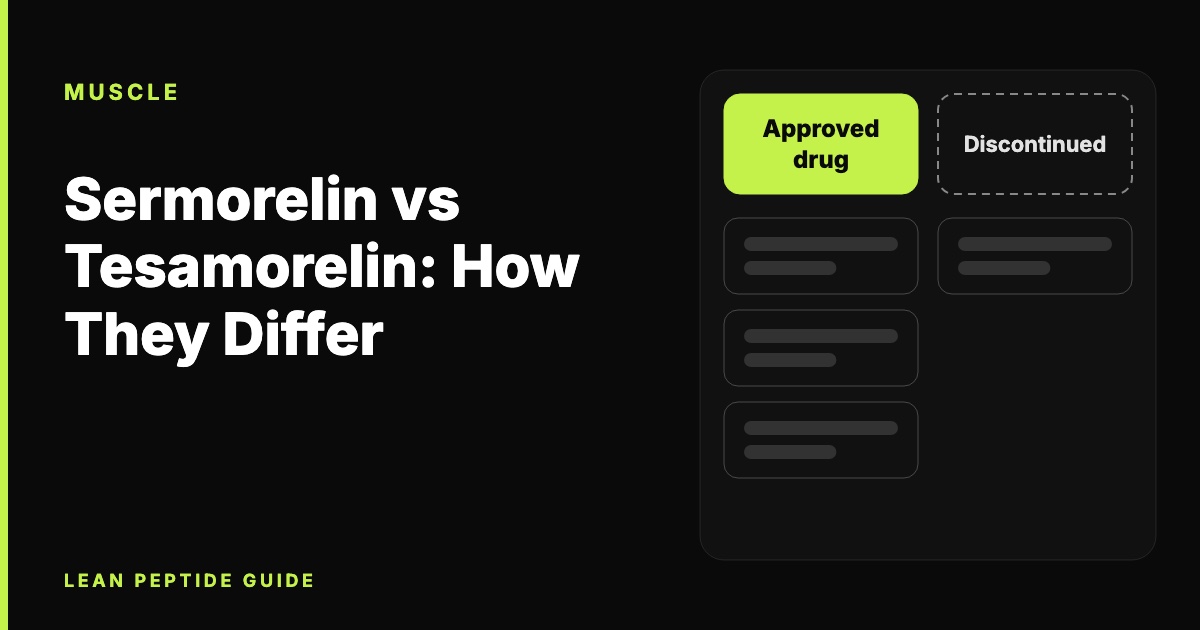
For tesamorelin the label wording is indicated for the reduction of excess abdominal fat, for a defined group of adults living with HIV and lipodystrophy. The same label lists limits of use, including that it is not indicated for weight loss management. Our sermorelin vs tesamorelin comparison covers the trial figures.
Reading each row more closely
Sermorelin. The FDA's 2013 Federal Register notice stated the Geref products "were not withdrawn for reasons of safety or effectiveness." It is a legal finding that lets other companies reference the old approvals, and it says nothing about muscle gain. The FDA's 2024 advisory committee briefing notes that sermorelin was the only GH secretagogue ever approved, for short stature caused by growth hormone deficiency, in children whose stimulation test showed a response. No GH secretagogue is approved for adult growth hormone deficiency. For the full history see the sermorelin profile and the sermorelin article.
Tesamorelin. The label's common adverse reactions in trials (over 5 percent of people) were joint pain, injection-site redness and itching, pain in the limbs, peripheral swelling and muscle pain. Contraindications include disruption of the hypothalamic-pituitary axis, active malignancy, hypersensitivity and pregnancy.
Ipamorelin. In its trial after bowel resection, given intravenously, two patients given ipamorelin died of complications, with the relationship unclear according to the FDA document, and low potassium and high blood sugar were more frequent. FDA's separate peptide safety page cites a risk of immunogenicity (the immune system reacting to the compound) and serious adverse events, including death with intravenous use, and says there is not enough information on other routes. Whether ipamorelin sits in a specific bulk-substance category is something two FDA pages appear to describe differently, so we make no category claim. Our statement is only that FDA has raised safety concerns.
CJC-1295. The FDA briefing reports adverse events in the small studies including injection-site reactions, headache, flushing, diarrhea, dizziness, low blood pressure and a faster heart rate. The same document says the maker withdrew a longer-acting form from trials in 2006 after a participant died in a phase 2 study, two hours after the eleventh weekly dose. The physician's view was undiagnosed coronary disease, a causal link was not established, and the data were never published. We mention it because it is part of the record, not to suggest a cause.
What the evidence does and doesn't show
This is the section we most want you to read carefully, because it is the one the marketing skips.
What the evidence shows
- GH-releasing peptides raise GH and IGF-1 in the short studies FDA reviewed for CJC-1295. That is a hormone measurement.
- In adults who are growth hormone deficient, GH therapy changes body composition. That population is diagnosed patients.
- Tesamorelin, in an approved indication, reduced visceral fat in adults with HIV and lipodystrophy. That population is narrow.
- Resistance training on 2 days a week and adequate protein have the most consistent support for gaining muscle in healthy adults.
What the evidence does not show
- No large trial that the FDA or the reviews we read cite shows that any of these four peptides increases muscle in healthy adults.
- Ibutamoren (also called MK-677) is a different compound from ipamorelin. Some reviews group results from the two, and we do not carry results from one over to the other.
- Short hormone studies do not tell you about long-term outcomes, safety or strength.
- Marketing lines about recovery or lean body composition are claims by sellers. They are not findings, and we do not repeat them as facts.
In short, we make no efficacy claim for any product on this page. Where a hormone moved in a study, we say that and nothing more.
Regulatory and sport notes
Federal law (21 USC 333(e)(1), as cited in an FDA briefing) bars knowingly distributing human growth hormone for any human use other than a disease or recognized medical condition authorized by HHS. That statute concerns growth hormone itself; we did not find a primary source applying it to these peptides, so we do not suggest it does.
On 2026-08-24 the FDA sent a warning letter to a seller, Peak Performance Peptides, that named tesamorelin among products it marketed as "research use only." The FDA found that research-use disclaimers did not change the intended-use findings. Sellers of this type sit in what we call the gray market, where nobody reviews the product's identity, purity or sterility before it reaches you. See peptides without a prescription for how that market works.
For athletes: USADA says sermorelin is prohibited in sport. For the other three, we did not confirm the current World Anti-Doping Agency wording from a primary page, so we make no claim about them beyond suggesting you check the current list yourself if you compete.
What Whoosh does and doesn't offer
Whoosh Wellness, the telehealth company this site is paid by through an affiliate arrangement, lists sermorelin among its products. Whoosh describes it with marketing phrases such as supporting the body's own growth hormone production and supporting lean body composition goals. Those are the company's descriptions. We make no efficacy claim for sermorelin, and the evidence above is thin. Whoosh does not offer tesamorelin, ipamorelin or CJC-1295, so there is no link to a Whoosh product on this page. Whoosh's compounded products are not FDA-approved, and a licensed physician decides whether any prescription is appropriate. Our Whoosh review describes what the company states about itself.
A sensible way to use this information
If you want to build muscle, the dependable levers are dull: progressive resistance training, protein across the day, sleep and time. If you are over 40, losing weight on a GLP-1, or have a medical reason to suspect a hormone problem, the person to talk to is a clinician who can test and examine you. A hormone deficiency is a diagnosis, and it is the situation in which the body-composition findings above apply.
Sources
- CDC: Adult Activity, An Overview read 2026-10-06
- ODPHP: Top 10 things to know about the Physical Activity Guidelines read 2026-10-06
- Morton et al. 2018, protein supplementation meta-analysis (PubMed 28698222) read 2026-10-06
- FDA advisory committee briefing, CJC-1295 and GH secretagogues, 2024-12-04 read 2026-10-06
- FDA advisory committee briefing, ipamorelin, 2024-10-29 read 2026-10-06
- Federal Register notice on Geref, 2013 read 2026-10-06
- Sinha et al. 2020, review of growth hormone secretagogues read 2026-10-06
- DailyMed: Egrifta SV (tesamorelin) label read 2026-10-06
- FDA: certain bulk drug substances that may present significant safety risks read 2026-10-06
- FDA warning letter to Peak Performance Peptides, 2026-08-24 read 2026-10-06
- USADA: Athletes, know sermorelin read 2026-10-06
- Whoosh Wellness: peptide therapy page read 2026-10-06
FAQ
Can any peptide build muscle?
No peptide is FDA-approved to build muscle in healthy adults. Studies of growth-hormone peptides mostly measured hormone levels. Resistance training and adequate protein have the strongest support.
Is sermorelin approved for muscle growth?
No. The brand product Geref was approved for a diagnostic use and for children with growth failure, and the manufacturer discontinued it in 2008. Compounded sermorelin is not FDA-approved.
Do GLP-1 drugs help you gain muscle?
No. They are approved for weight-related uses on their labels, and trials show some lean mass is lost along with fat. Lean mass measured by DXA also includes water and organs, so it is not the same as muscle.
Is tesamorelin a muscle or weight loss drug?
No. Its label says it is indicated for the reduction of excess abdominal fat, for a defined group of adults living with HIV and lipodystrophy and not indicated for weight loss management.
What did the 2018 protein meta-analysis find?
Morton and colleagues pooled 49 trials with 1,863 participants. Protein supplementation added 0.30 kg of fat-free mass, with no extra gain above a total intake of 1.62 g/kg/day, and the effect shrank with age.
Does Whoosh sell a muscle peptide?
Whoosh lists sermorelin and says what it says about it. We make no efficacy claim. It does not offer tesamorelin, ipamorelin or CJC-1295. A licensed physician decides whether a prescription is appropriate.
Are "research use only" peptides legal to buy for personal use?
The FDA has said research-use labels did not override intended-use findings in warning letters. We are not offering legal advice; the point is that these products are not reviewed for safety or quality.
Not medical advice. See the medical disclaimer.