Quick answer: Tesamorelin (Egrifta) is an FDA-approved drug, but only for reduction of excess abdominal fat in HIV-infected adults with lipodystrophy, and its label says it is not indicated for weight loss management. Sermorelin is a related growth-hormone-releasing analog whose brand product, Geref, was discontinued in 2008. Sermorelin sold today is compounded and not FDA-approved. Whoosh offers sermorelin, not tesamorelin.
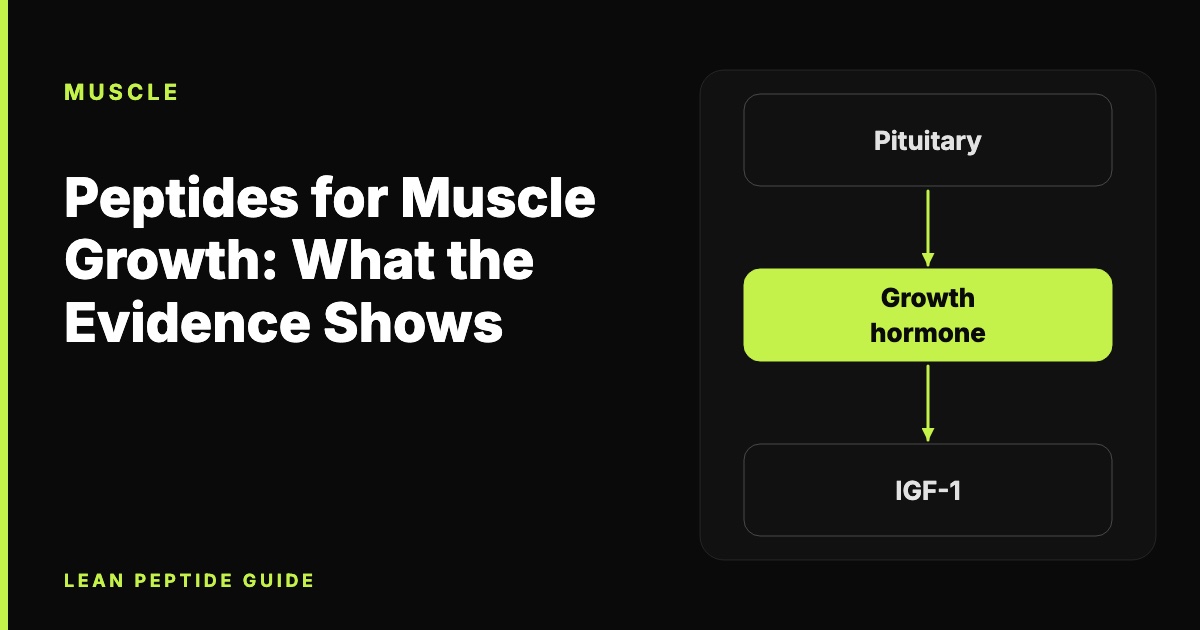
These two peptides get compared because both are analogs of GHRH, the hormone that tells the pituitary to release growth hormone. That family resemblance hides a large difference: one has a current FDA label with trial results behind it, and the other does not. This page lays out that difference with the exact label language, the trial figures, and a side-by-side table. For the history of sermorelin alone, see our sermorelin article; for how these peptides fit the muscle question generally, see the muscle growth guide.
Plain-text note on partners: Whoosh Wellness does not sell tesamorelin. It lists sermorelin, so you will find no Whoosh button on this page, and no affiliate link.
The shared family, and why they are not the same
Both peptides act on the GHRH receptor in the pituitary. Sermorelin is described as an analog made from the front part of the natural hormone. Tesamorelin, according to its label, is a 44-amino-acid growth hormone-releasing factor analog carrying a hexenoyl group, a chemical addition that changes how it behaves in the body. Its initial U.S. approval was in 2010; we did not establish the month and day.
That is the extent of the similarity that matters. One is a modified molecule that went through a full FDA drug review for a defined population. The other was approved long ago for narrow pediatric and diagnostic uses and then stopped being made.
Tesamorelin: what the label says
We read the Egrifta SV label on DailyMed on 2026-10-06. Several points deserve exact language, because this is where marketing often drifts.
The indication is written as indicated for the reduction of excess abdominal fat in HIV-infected adults with lipodystrophy. That is the entire approved use. It is not a use for obesity in general, for people without HIV, for athletes or for anyone seeking muscle.
The label's limitations of use state three things: that long-term cardiovascular safety has not been established, that tesamorelin is not indicated for weight loss management, and that there is no evidence of improved antiretroviral adherence. Take the middle phrase as the most important line for anyone reading a seller's page that implies otherwise.
Common adverse reactions, reported by more than 5 percent of people in the label's trials, were joint pain, redness and itching at the injection site, pain in the arms and legs, swelling in the extremities and muscle pain. Contraindications listed are disruption of the hypothalamic-pituitary axis, active malignancy, hypersensitivity and pregnancy.
Tesamorelin: what the trials measured
The label summarizes two studies at week 26, measuring visceral adipose tissue, which is the fat packed around the abdominal organs. In Study 1 the mean change was -18 percent with tesamorelin, compared with +2 percent for placebo. In Study 2 the mean change was -14 percent with tesamorelin. We give the placebo figure for Study 1 only, because we could not re-check the sign of the placebo change for Study 2 in the full label, and we would rather leave a number out than guess.
The pivotal published trial is Falutz and colleagues in the New England Journal of Medicine in 2007. It was randomized, double-blind and placebo-controlled, lasted 26 weeks and enrolled 412 people with HIV and abdominal fat. Visceral fat changed by -15.2 percent on tesamorelin versus +5.0 percent on placebo (P<0.001). Triglycerides moved by -50 mg/dL versus +9 mg/dL.
Three points of context:
- Who was studied. Adults with HIV and excess abdominal fat linked to lipodystrophy. The results do not transfer to healthy adults, to people without HIV or to general weight loss.
- What was measured. Visceral fat, a body-composition measure, and blood fats. Muscle gain was not the label's headline outcome, and weight loss is expressly outside the indication.
- What these figures describe. They belong to the approved drug and its trial population. Nobody should apply them to a compounded or "research" product from another source.
Sermorelin: the other side of the comparison
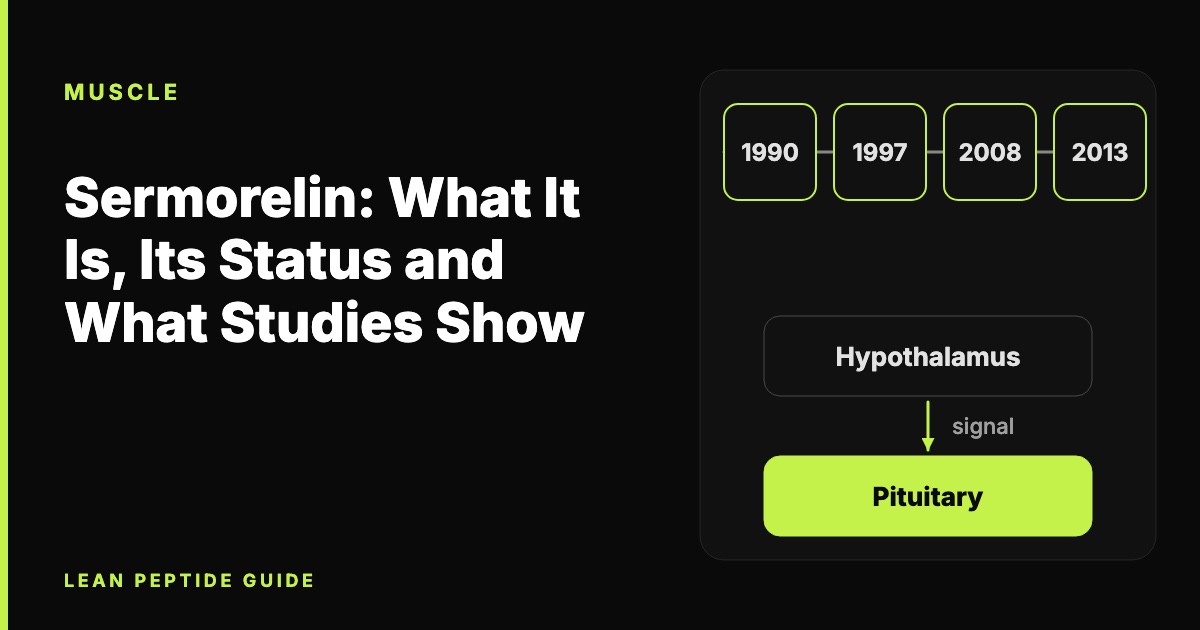
Sermorelin's regulatory record is older and thinner. The brand Geref was approved in 1990 for a diagnostic use and in 1997 for children with growth failure from idiopathic growth hormone deficiency, and the manufacturer discontinued it in 2008. A 2013 FDA notice said the products were not withdrawn for safety or effectiveness reasons, which is a technical determination and not an endorsement.
On weight and body composition, the evidence is the small-study material found in a 2020 review by Sinha and colleagues, which uses the word "paucity" about the clinical data. A 16-week study saw more lean mass but no change in weight or fat mass, and a 6-week study saw no significant change in weight, BMI, waist-hip ratio, lean mass or percent fat. There is no sermorelin counterpart to a 412-person, placebo-controlled, 26-week trial. For the details of that review, the sermorelin profile is the better place.
Sermorelin sold now is compounded and not FDA-approved. Check the FDA's 503A bulks list (version updated 2026-05-14) and you will find it in none of Categories 1, 2 or 3. A compounding pharmacy's product has not been reviewed by FDA for safety, effectiveness or quality, whereas tesamorelin's label comes from a full review.
Compare table
| Question | Sermorelin | Tesamorelin |
|---|---|---|
| Mechanism | Analog of GHRH; acts on the GHRH receptor | Analog of GHRH (growth hormone-releasing factor); label says 44 amino acids |
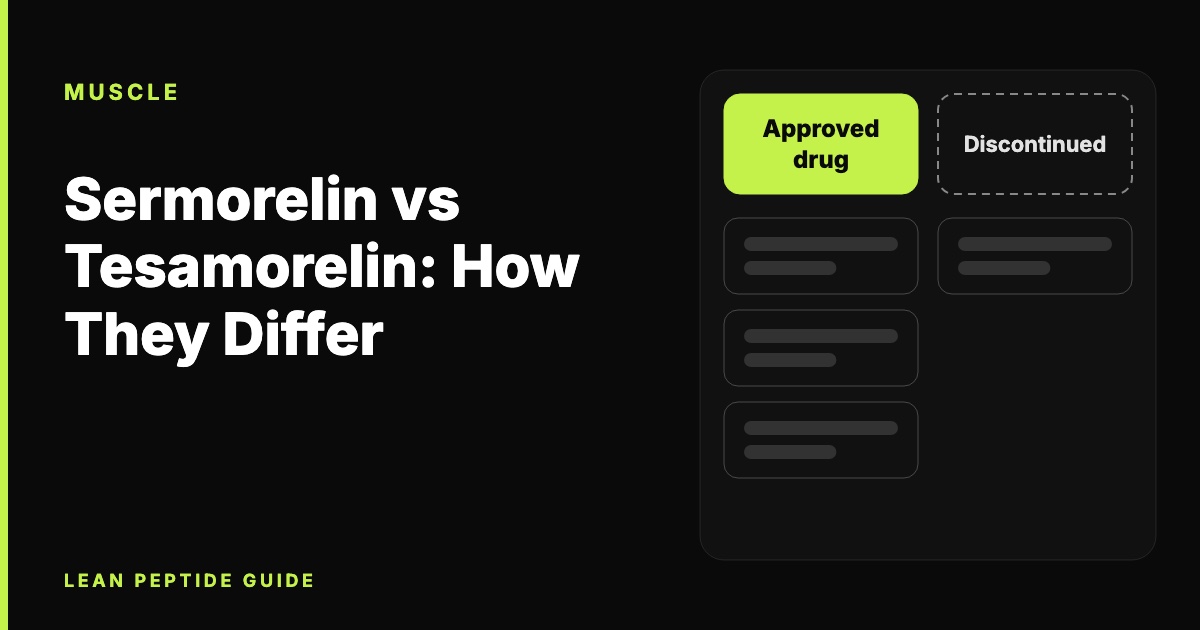
| FDA-approved today? | No. Brand Geref approved 1990 and 1997, discontinued 2008 | Yes (Egrifta), initial U.S. approval 2010 |
| Approved use | None current. Past: diagnostic ampule; children with growth failure | indicated for the reduction of excess abdominal fat in HIV-infected adults with lipodystrophy |
| Label statement on weight loss | Not applicable | not indicated for weight loss management |
| Key human data | Two small 1997 studies in adults, per a 2020 review | 26-week trials: visceral fat -18% and -14% (label); -15.2% vs +5.0% (Falutz, NEJM 2007) |
| Population in the data | Healthy or experimentally hypogonadal adults, small | Adults with HIV and abdominal fat, hundreds of participants |
| Most common effects reported | Flushing, injection-site pain (pediatric review) | Joint pain, injection-site redness and itching, limb pain, swelling, muscle pain |
| Sport | USADA: prohibited | Not confirmed from a primary page |
| Offered by Whoosh? | Yes, as injection or tablets | No |
Why the difference matters when you read a seller's page
A seller who lists both names together is often borrowing authority. Tesamorelin has an FDA label, so a page that lists it next to sermorelin can make sermorelin seem to share that standing. It does not. The label is specific to one product, one population and one use, and the label itself rules out weight loss management.
There is a second reason for care. On 2026-08-24 the FDA issued a warning letter to a Phoenix seller, Peak Performance Peptides, that named tesamorelin among products marketed as "research use only." The agency found that the research-use disclaimers did not defeat its intended-use findings. That is the gray market in action: a product that has a legitimate approved form, sold in an unreviewed form with claims the label does not support. Our guide on are peptides safe sorts sources by how much you can trust them.
Where Whoosh fits
Whoosh Wellness lists sermorelin as one of its products and describes it in marketing language that we do not adopt as fact. It does not offer tesamorelin. If you see tesamorelin advertised alongside a Whoosh product, that is not coming from Whoosh's own product list as we read it on 2026-10-06. Its compounded products are not FDA-approved, and prescribing is a licensed physician's call. Our Whoosh review records what the company states.
What we can and cannot conclude
We can conclude that tesamorelin has a defined, label-backed use and trial figures for that use, while sermorelin has an old regulatory history and little adult data. We cannot conclude that either helps healthy adults lose weight or gain muscle, because the evidence we read does not show it. And we cannot conclude that a lower visceral fat figure in an HIV lipodystrophy trial says anything about a person outside that group.
Sources
- DailyMed: Egrifta SV (tesamorelin) label read 2026-10-06
- Falutz et al., NEJM 2007, record via Europe PMC (PMID 18057338) read 2026-10-06
- Federal Register notice on Geref, 2013-03-04 read 2026-10-06
- FDA: 503A bulks list categories, updated 2026-05-14 read 2026-10-06
- Sinha et al. 2020, review of growth hormone secretagogues read 2026-10-06
- BioDrugs review of Geref in children (PubMed 18031173) read 2026-10-06
- FDA warning letter to Peak Performance Peptides, 2026-08-24 read 2026-10-06
- USADA: Athletes, know sermorelin read 2026-10-06
- Whoosh Wellness: peptide therapy page read 2026-10-06
FAQ
Is tesamorelin approved for weight loss?
No. Its label says it is not indicated for weight loss management. The approved use is indicated for the reduction of excess abdominal fat in HIV-infected adults with lipodystrophy.
What did the tesamorelin trials find?
In the label's studies at 26 weeks, visceral fat changed by -18% and -14% on tesamorelin. In Falutz et al. (NEJM 2007, 412 people with HIV), it was -15.2% versus +5.0% on placebo.
Is sermorelin the same as tesamorelin?
No. Both relate to GHRH, but tesamorelin is a modified 44-amino-acid analog with an FDA label. Sermorelin's brand product was discontinued in 2008 and compounded sermorelin is not FDA-approved.
Does Whoosh sell tesamorelin?
No. Whoosh lists sermorelin, offered as injection or tablets, and does not list tesamorelin. A licensed physician decides whether a prescription is appropriate.
Can the tesamorelin results be applied to healthy adults?
No. The trials enrolled adults with HIV and abdominal fat from lipodystrophy. The figures belong to that population and that approved drug.
What are tesamorelin's common side effects?
The label lists joint pain, injection-site redness and itching, limb pain, peripheral swelling and muscle pain as the most common adverse reactions, reported in more than 5 percent of people.
Why did FDA mention tesamorelin in a warning letter?
A 2026-08-24 letter named tesamorelin among products a seller marketed as "research use only." FDA said the disclaimers did not change its findings about intended use.
Not medical advice. See the medical disclaimer.